In today’s rapidly evolving digital landscape, the way people search for information is changing faster than ever. Traditional SEO is no longer the only approach brands need to stay discoverable. With advancements in AI, voice-enabled devices, and hyperlocal targeting, two new power players have joined the search ecosystem – AEO (Answer Engine Optimization) and GEO (Generative Engine Optimization). Together, these three forces are shaping the next era of visibility, customer engagement, and brand authority.
This guide breaks down what AEO, SEO, and GEO are, how they work, their key differences, the advantages of combining them, and how businesses can begin implementing the future-ready approach to search optimization.
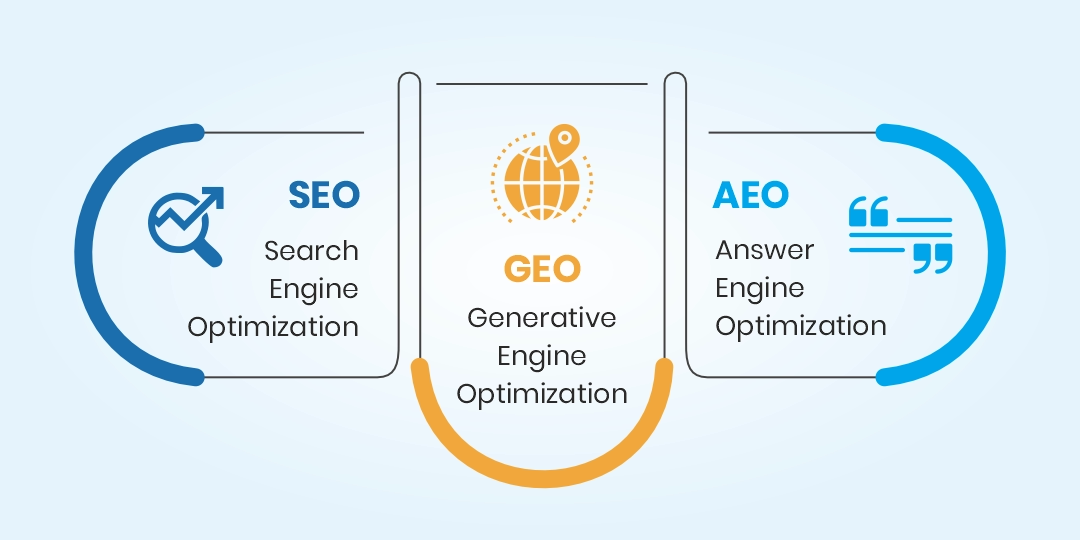
SEO focuses on optimizing content so that search engines like Google can understand, index, and rank it. It revolves around keywords, backlinks, technical optimization, content structure, and user experience. SEO helps websites appear in organic search results, bringing consistent, high-intent traffic.
AEO is optimization for answer engines – platforms that deliver direct answers, such as Google’s Featured Snippets, voice assistants (Alexa, Siri, Google Assistant), and AI chatbots. Instead of ranking links, these engines pull concise, structured answers. AEO ensures your content is recognized as the best response to user questions.
GEO is the newest specialization. It focuses on optimizing content for AI-powered generative engines like ChatGPT, Gemini, Perplexity, and SGE (Search Generative Experience). These tools do not simply list websites; they generate answers based on aggregated content. GEO increases the chances that AI tools reference and amplify your brand in generated results.
SEO works by helping search engines like Google crawl, index, and understand your website so it can rank higher in organic search results. It uses keyword research, optimized metadata, backlinks, internal linking, technical improvements, and high-quality content to signal relevance and authority. When these elements align, search engines display your pages to users searching for related topics, driving consistent and high-intent traffic.
AEO focuses on optimizing content for answer engines that deliver instant responses, such as Google’s Featured Snippets, People Also Ask sections, and voice assistants like Siri, Alexa, and Google Assistant. It works by structuring information into clear Q&A formats, adding schema markup (FAQ, How-To, Local Business), and writing concise, precise answers that algorithms can easily extract. The goal is to position your content as the most reliable, direct answer to user questions.
GEO is designed for AI-driven generative engines like ChatGPT, Gemini, Perplexity, and Google’s SGE. These tools don’t just list websites; they generate summaries, insights, and recommendations. GEO works by creating deep, context-rich, conversational content that AI models can interpret and confidently reference. It emphasizes expertise, clarity, structured insights, and consistent brand presence across platforms, ensuring your information is favored and cited in AI-generated responses.
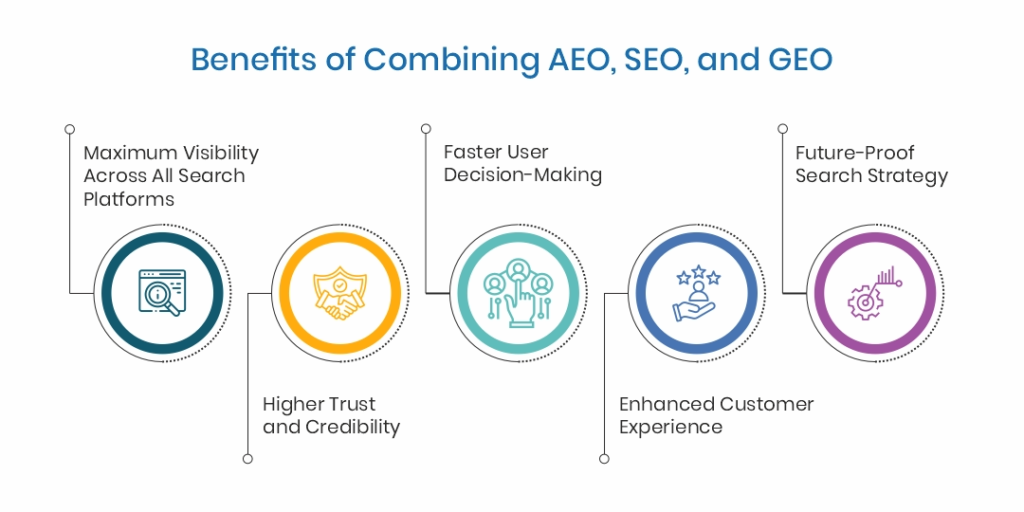
When these three are integrated, businesses unlock a powerful, future-ready advantage:
Whether someone uses Google search, Alexa, Siri, or AI assistants like ChatGPT and Gemini, your brand becomes discoverable in every search format. This multi-channel presence ensures your content reaches users wherever they choose to search, increasing your organic reach and reducing dependency on a single platform.
Appearing in Google’s Featured Snippets, being referenced by answer engines, or being cited by AI tools significantly boosts your brand authority. Users naturally trust information that is highlighted or recommended by search and AI systems, and this credibility directly influences conversions and brand reputation.
AEO gives quick, precise answers, SEO offers detailed information, and GEO provides intelligent, contextual explanations. Together, they guide users through the entire research and decision-making journey faster, reducing friction and helping customers take action with greater confidence.
By optimizing for text-based search, voice search, and AI-generated responses, your content becomes accessible and helpful in every format. This creates a seamless user experience where customers get accurate, relevant information instantly, no matter how they choose to search or interact with your brand.
As AI-driven search continues to grow, businesses that adopt GEO early will stay ahead in visibility and relevance. Combining AEO, SEO, and GEO ensures your brand remains strong even as search engines evolve, protecting your digital presence against future algorithm changes and new user behaviors.
First, improve your SEO basics. Choose strategic, high-intent keywords, optimize your metadata, and ensure your website is technically strong with fast loading, mobile responsiveness, and clean architecture. Build high-quality backlinks and strengthen your internal linking system so both users and search engines can navigate your content easily. These foundational steps make your site more visible and trustworthy in traditional search results.
Second, build content tailored for AEO. Focus on how modern users ask questions—especially through voice search and AI assistants. Add FAQ sections, How-To formats, and structured Q&A blocks. Use schema markup like FAQ, How-To, and Local Business schema to help search engines extract your answers clearly. Create short, direct, authoritative responses so your content is more likely to appear in featured snippets, voice responses, and AI-powered answer boxes.
Next, enhance your GEO (Generative Engine Optimization) signals. Unlike local SEO, GEO focuses on optimizing content so AI-driven generative engines such as ChatGPT, Gemini, Perplexity, and Google’s SGE can understand, summarize, and cite your information accurately. To strengthen GEO, create in-depth, context-rich content that answers broad and complex questions—not just simple queries. Add expert opinions, comparisons, data-backed insights, and well-structured long-form explanations, as generative AI tools pull from deeper content pools. Maintain consistent messaging across your website, blogs, social platforms, and brand profiles because AI engines evaluate your overall digital footprint—not just individual pages. Publish authoritative content that signals expertise, experience, and credibility, which increases the chances of being referenced in AI-generated responses.
To make all this more effective, use tools like Google Search Console, Google Analytics, keyword finders, and schema generators to monitor performance and identify opportunities. You can also use AI tools for topic research, competitor analysis, and content gap insights. These tools help you understand what is working, what needs improvement, and how your brand is performing across traditional search, answer engines, and generative AI platforms.
The next wave of search is shifting from link discovery to answer delivery. With AI dominating the discovery journey, users expect instant, accurate, contextual information. Brands that rely solely on traditional SEO may slowly lose visibility.
As AI engines become smarter, they will prioritize content that demonstrates expertise, clarity, consistency, and credibility.
At a time when digital ecosystems are changing every month, businesses need more than traditional SEO — they need a future-ready search strategy. This is where Priyam Consultancy Services (PCS) becomes a powerful partner.
PCS helps brands integrate the power of SEO, AEO, and GEO into a unified search optimization framework. From building structured content that ranks on Google, to crafting precise answers for voice search, to shaping expert-led content that AI engines trust, PCS ensures your brand stays visible across every discovery platform.
With a blend of technical expertise, digital strategy, and creative content development, PCS enables businesses to stay ahead of evolving search trends, reach the right audience in the right moment, and build authority that lasts. As search moves toward generative, conversational, and answer-driven models, PCS equips your brand with everything needed to lead this new era of digital visibility.