Understanding Industry-Specific AI Marketing
Industry-Specific AI Marketing truly represents the next evolution of AI-driven digital marketing. In today’s increasingly competitive landscape, a single intelligent system can effectively adapt its strategies based on industry behavior, regulations, and customer intent. As a direct result, instead of relying on generic automation, businesses are increasingly turning to AI-powered digital marketing tools that not only understand sector-specific needs but also deliver more personalized and impactful outcomes.
Unlike traditional digital marketing approaches, artificial intelligence in digital marketing enables brands to analyze vast datasets, predict behavior, personalize messaging, and automate decisions — all while aligning with industry realities. A healthcare brand, for example, requires compliance-led communication, while an eCommerce brand focuses on speed, personalization, and conversion optimization.
This is where AI marketing for industries becomes powerful: one AI platform, many industry-aligned strategies.
Why One-Size-Fits-All AI Marketing No Longer Works
As digital marketing trends continue to shift toward personalization and automation, one-size-fits-all AI models are proving ineffective. Industries differ significantly in customer journeys, decision-making timelines, data sensitivity, and compliance obligations.
Regulatory and Compliance Differences
- Healthcare must align with patient privacy and ethical communication
- Financial services require risk disclosures and suitability checks
- Education, real estate, and legal sectors operate under strict communication guidelines
Generic AI-powered digital marketing services often overlook these nuances, creating risk rather than value.
Customer Intent and Behavior Variations
- B2B industries have longer buying cycles and multiple stakeholders
- Retail and D2C brands depend on impulse triggers and repeat purchases
- Professional services rely on trust, authority, and relationship-building
Industry-Specific AI Marketing ensures AI adapts its logic, messaging, and automation to how customers actually behave in each sector.
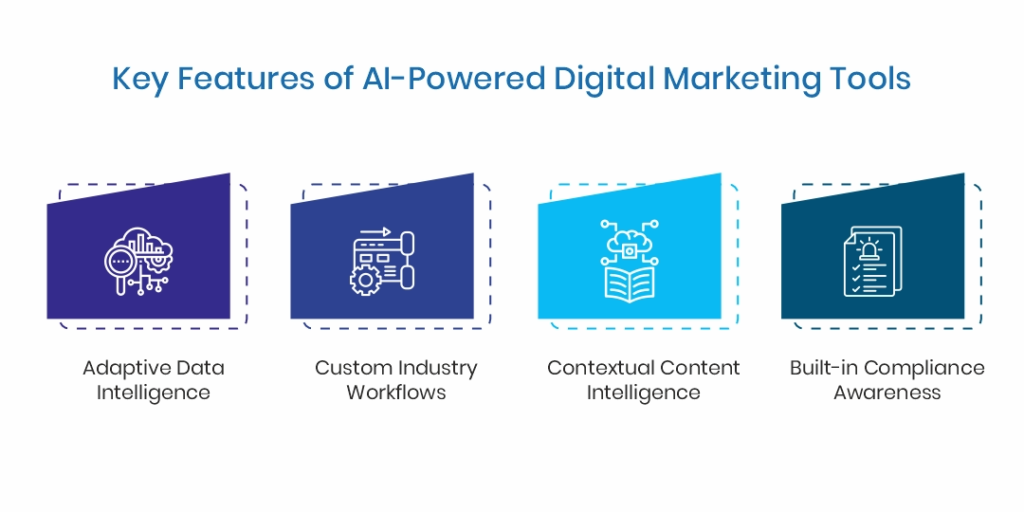
Key Features of AI-Powered Digital Marketing Tools
Modern AI-powered digital marketing tools are built to be flexible, intelligent, and scalable across industries. Industry-Specific AI Marketing ensures that a single AI system adapts its intelligence based on sector requirements rather than applying generic automation.
Adaptive Data Intelligence
AI integrates with CRMs, ERPs, healthcare systems, POS tools, and analytics platforms to understand context — not just clicks. This enables AI-driven digital marketing decisions based on real business data, which is the foundation of effective Industry-Specific AI Marketing.
Custom Industry Workflows
Different industries require different automation paths:
- Healthcare → patient education and follow-ups
- Real estate → long-term lead nurturing
- SaaS → product-led onboarding and retention
AI-powered digital marketing services allow workflows to be designed around industry-specific funnels rather than fixed templates.
Contextual Content Intelligence
Artificial intelligence in digital marketing now understands tone, urgency, and credibility requirements. Messaging adapts automatically — professional for finance, emotional for lifestyle brands, and educational for healthcare.
Built-in Compliance Awareness
Advanced AI tools flag non-compliant messaging, ensuring campaigns align with industry regulations before launch and protecting brands operating in regulated sectors.
Healthcare & Medical Services
Healthcare organizations use AI digital marketing services to improve patient engagement while maintaining compliance.
Key applications include:
- AI-driven patient education campaigns
- Automated appointment reminders
- Review and reputation management
- Post-treatment communication journeys
AI ensures messaging is personalized, timely, and compliant.
Retail & eCommerce
Retail brands rely heavily on AI-powered digital marketing to manage scale and speed. Use cases include:
- Predictive product recommendations
- Dynamic pricing and inventory-based campaigns
- Cart abandonment automation
- Loyalty and retention journeys
AI in digital marketing enables retailers to react in real time to consumer behavior.
Construction
Construction companies use AI-powered digital marketing to generate high-intent leads and build long-term credibility in competitive markets.
Use cases include:
- AI-driven lead qualification for projects and tenders
- Location-based campaign targeting for ongoing and upcoming projectsLocation-based
- campaign targeting for ongoing and upcoming projects
- Automated follow-ups for inquiries, bids, and consultations
- Reputation and review monitoring to strengthen trust and authority
- AI in digital marketing helps construction brands forecast demand, prioritize serious buyers, and stay visible throughout long decision-making cycles.
Financial Services
Banks and financial institutions depend on AI for precision and trust. AI marketing for industries like finance focuses on:
- Personalized product recommendations
- Life-event–triggered campaigns
- Fraud awareness communication
- Customer education initiatives
Here, AI-driven digital marketing balances personalization with regulation.
Professional & B2B Services
Consulting firms, agencies, and service providers use AI to strengthen authority and lead quality. Applications include:
- Thought leadership content distribution
- Lead scoring and qualification
- Case study automation
- Referral relationship nurturing
AI helps businesses remain consistent, credible, and visible.
Implementation Best Practices for Industry-Specific AI Marketing
Professional & B2B Services
Instead of generic KPIs, define success metrics based on industry benchmarks — patient engagement, lead quality, repeat purchase rate, or trust signals.
Prioritize Clean, Structured Data
AI-powered digital marketing tools rely on accurate data. Poor data leads to poor automation. Ensure integrations are clean and continuously updated.
Train Teams Alongside AI
AI Updated in Digital Marketing doesn’t replace marketers — it augments them. Teams should understand how to interpret AI insights and apply strategic judgment.
Roll Out in Phases
Start with a single use case (email automation, ad optimization, personalization) and expand as the AI learns.
Measuring Success Across Industries
Success metrics differ based on industry goals.
Healthcare
- Patient engagement levels
- Appointment adherence
- Feedback and satisfaction scores
Retail
- Conversion rate growth
- Average order value
- Repeat purchase frequency
Professional Services
- Lead-to-client conversion
- Brand authority growth
- Referral volume
AI-powered digital marketing services deliver compounded results over time as systems learn and adapt.
Common Challenges and How AI Solves Them
Data Privacy & Security
AI platforms now include encryption, access control, and compliance frameworks tailored to industries handling sensitive data.
System Integration
Modern AI marketing tools offer industry-specific integrations, reducing complexity and setup time.
Human vs Automation Balance
The best AI-driven digital marketing strategies automate processes while preserving human interaction where trust matters most.
Future Trends in Industry-Specific AI Marketing
As digital marketing trends continue to evolve, AI will become more predictive, contextual, and proactive.
Human vs Automation Balance
As digital marketing trends continue to evolve, AI will become more predictive, contextual, and proactive.
Cross-Industry Intelligence
AI systems will learn patterns across industries while respecting regulatory boundaries.
Built-In Regulation Intelligence
AI marketing platforms will auto-adjust to regulatory changes, reducing compliance risk
Conclusion
Industry-Specific AI Marketing isn’t about using more tools — it’s about using the right intelligence in the right way. At Priyam Consultancy Services (PCS), AI-powered digital marketing is designed to adapt to each industry’s audience behavior, market dynamics, and growth goals.
By partnering with PCS, businesses gain:
- Higher operational and marketing efficiency
- Smarter, data-driven personalization
- Faster, insight-led decision-making
- Scalable strategies built for long-term growth
As artificial intelligence continues to reshape digital marketing, the brands that win are those guided by industry-aware AI strategies — not generic automation. PCS bridges AI capability with real-world business understanding to drive visibility, trust, and measurable growth.