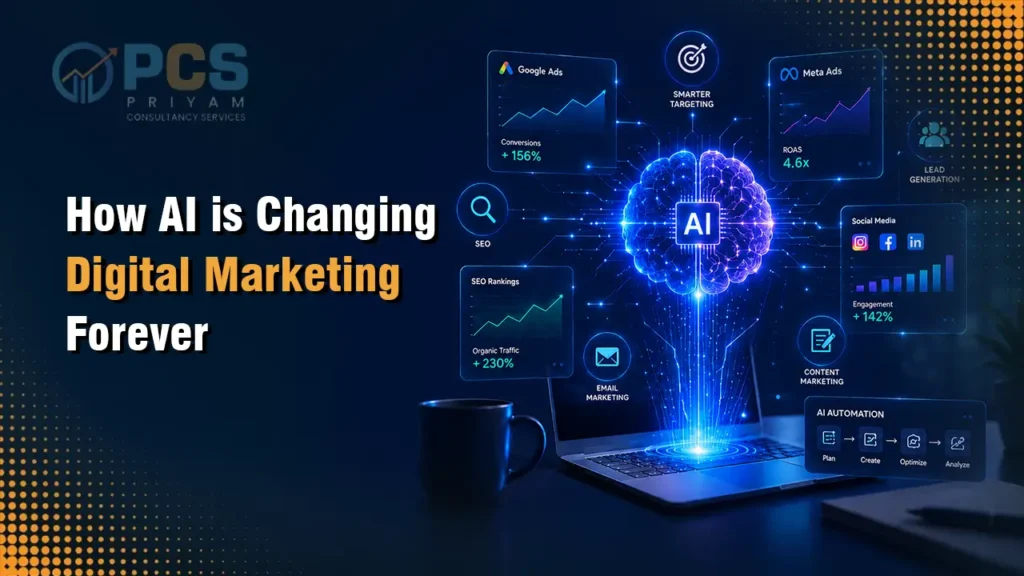
How AI is Changing Digital Marketing Forever
How AI is Changing Digital Marketing Forever If you’ve been running ads, posting content, and chasing leads without seeing consistent results, you’re not alone. Marketing today feels harder than it used to — costs keep rising, customers scroll past generic content, and it’s tough to know what’s actually working until it’s too late. At the same time, one word keeps coming up everywhere: AI. It’s in your ad platform, your email tool, even your competitor’s chatbot. But most business owners aren’t asking “what is AI” anymore — they’re asking whether AI in digital marketing actually solves real problems, or if it’s just another trend to keep up with.This blog breaks that down simply. No confusing tech talk — just what AI is really changing about digital marketing, why it matters for growing businesses, and how you can start using it without overhauling everything you already do. What Is AI in Digital Marketing? In simple terms, AI in digital marketing means using smart tools to handle the repetitive, data-heavy parts of marketing — so decisions get faster and more accurate, without needing a bigger team.Instead of manually guessing which ad performs better or spending hours analyzing spreadsheets, AI tools can: Study customer behavior and predict what they’re likely to respond to Generate and refine content in a fraction of the time Flag what’s working (and what isn’t) almost instantly It’s not about replacing how you think about your business — it’s about removing the slow, manual work that was never a good use of your time in the first place.To see how far this has come, it helps to look at two developments already shaping the direction marketing is heading in: agentic AI and emerging brain-response research. From Manual Guesswork to Automated Marketing Agentic AI doesn’t just respond to one prompt and stop — it takes a goal, breaks it into steps, acts on it, checks results, and adjusts, with far less step-by-step management needed from a person. In practice, a tool like Claude, connected through a workspace like Claude Cowork, can be set up to draft a blog post, turn it into a LinkedIn post and Instagram carousel, and pull in competitor research as part of one connected workflow — with a person setting the goal and reviewing the output along the way, rather than typing out each step manually. Worth mentioning separately: Meta FAIR recently released a research model called TRIBE v2. It’s important to be accurate about what this actually is — it’s a neuroscience model trained on fMRI brain scans from over 700 volunteers, built to predict how the brain responds to sights, sounds, and language, mainly for medical and cognitive research. It isn’t a marketing tool, and no major ad platform currently uses it for content scoring. That said, it points to something marketers have long worked with intuitively: simple language, a strong hook, a clear payoff, and a message that doesn’t feel like a hard sell all tend to perform better on fast-scrolling platforms like Instagram, because that’s genuinely how attention and comprehension work in the brain. TRIBE v2 doesn’t hand businesses a ready-made scoring tool today — but it’s an early sign that the science behind “why some content grabs attention and some doesn’t” is becoming more precise, and that’s likely to filter into marketing tools over time. Here’s how AI-driven automation — agentic AI, not TRIBE v2 — is already showing up across the channels most businesses use: Channel Before AI After AI Instagram Post and hope it performs; find out what worked days later Multiple captions/hooks tested quickly; best performer identified faster Meta Ads Manually build audiences, adjust budget after checking reports Advantage+ finds high-intent users; budget shifts in real time Google Ads Set keywords and bids manually, adjust weekly Performance Max automates bidding, reallocating spend as it learns Search (SEO) Guess topics, wait weeks to see if rankings move AI tools help discover high-intent keywords by analyzing search data, competition, and user intent The pattern is the same across all four: less guessing, faster feedback, and budget that moves toward what’s actually working. Why Are Businesses Spending More on Marketing but Getting Fewer Results? This is the frustration a lot of business owners quietly deal with. Ad costs keep climbing every year, yet leads and conversions don’t grow at the same rate. A few reasons why: More competition, same audience. Every business is fighting for the same attention online, which drives costs up. Generic content gets ignored. Customers can tell when messaging feels copy-pasted instead of relevant to them. Decisions are made too late. By the time a monthly report shows what went wrong, the budget’s already spent. Manual processes can’t keep up. Without automation, teams simply can’t test, adjust, and optimize fast enough.This is exactly the gap AI for digital marketing is closing — not by spending more, but by spending smarter. Here’s a simple way to picture it: if two businesses spend the same amount on ads, but one uses AI to identify high-intent customers while the other targets broadly and hopes for the best, the difference in results won’t stay small — it compounds month after month. Over a year, that gap often decides which business scales and which one plateaus. How to Use AI to Solve Everyday Marketing Challenges AI becomes useful the moment you apply it to a specific, everyday problem. Here’s how that plays out in practice:If your ad budget feels wasted, AI-driven targeting narrows your audience to people who are actually likely to convert, instead of showing your ad to everyone. If your team struggles to keep up with content demands, AI tools can draft blogs, captions, and ad copy in minutes, giving your team more time to refine and strategize instead of starting from a blank page. And if you’re unsure why a campaign underperformed, AI-powered analytics explain the “why” in real time — not three weeks later, once the budget’s already gone. The pattern is simple: AI doesn’t replace your strategy.