Your brand can rank on page one of Google and still never appear in a ChatGPT, Perplexity, or Google AI Overviews answer. More people now ask AI tools for recommendations before they ever open a search results page, so being a source those tools cite has become a visibility channel.
This article highlights the upcoming trends in online business growth for 2027.
Key Takeaways
- AI is influencing both how brands market and how consumers discover products.
- Well-organised, rich in information product pages make it more likely that the products will be discovered using both traditional and AI-based search engines. No one can guarantee you inclusion.
- First-party personalisation is most effective when consumers know what they will receive in return for giving away their data.
- Social commerce and marketplace advertising turn discovery channels into conversion channels.
- Email, SMS, and lifecycle automation lower dependency on costly customer acquisition.
- Measure profits, not just traffic or ROAS.
- A good eCommerce website built with technical expertise in mind is a basis for digital marketing.
How Is AI Transforming eCommerce Marketing?
AI is now integrated into marketing campaigns on ecommerce platforms. It assists in developing product descriptions, categorizing the audience, managing bids, predicting demand, and responding to customer inquiries faster than any team could. In a competitive environment where a slight change in pricing, listing, and budgeting makes an impact instantly, that speed becomes essential.
The greatest value of AI comes with the presence of humans who make decisions and ensure that a company’s branding isn’t violated. The companies that are going to succeed in the market would use the benefits of AI and human wisdom rather than automate everything or neglect AI entirely.
AI Search, Answer Engines and Product Discovery
More and more people ask questions to an AI assistant or search engine (e.g. “which running shoes will work for flat feet?”) and get an answer in brief form. In order to appear in such cases, your product pages have to be:
- Crawlable and technically SEO-friendly: pages that the search engine can crawl, render and index easily.
- Correct structured data and product feeds: correct price, availability, attributes and unique identifiers like GTINs, synchronized across channels.
- Useful and original content: descriptions, comparisons and guides that will answer questions, not just copy manufacturer’s text.
- Reviews and trust indicators: customer reviews and clear information about returns and delivery.
Following Google technical guidelines and SEO recommendations is not a guaranteed way to appear in AI-generated search results (
Google Search Central). The reasonable approach is to increase the chances of appearance.
Personalisation and Customer Experience
Relevant recommendations are key expectations of consumers. Personalisation involves more than addressing a consumer by his/her first name in an e-mail. This involves:
- Segmentation of customers according to purchasing behavior, browsing interests, order amount and lifecycle.
- Trigger events such as browser abandonment, cart abandonment emails, stock return notifications and replenishment notifications.
- In-sight personalization through product recommendations, banners and offers.
- Consent management through notification of the use of data and preference management of consumers.
Personalization should seem helpful rather than intrusive.
Social Commerce and Marketplace Advertising
Social media platforms are now becoming the new discovery and purchase points. The use of shoppable posts, live commerce, and partnerships with creators can take a customer from discovery to purchase in a very short time. In-app checkout varies depending on the platform and market. Make sure you know what’s available in your category and country before designing a plan.
Either way, social media content should be treated as the sales channel. Video content, creator reviews and user-generated content are often more credible than any advertisement.
Marketplaces are just as crucial because buyers are coming here with the intention to purchase. You should have excellent listings, correct product information, reviews, and good ad management. This is where Amazon PPC services can help you.
How AI Search Systems Retrieve, Evaluate, and Cite Sources
In the context of strict privacy regulations and less third-party tracking options, the first party data (data voluntarily shared by the customer) is an important part of the marketing assets. This comprises email addresses, purchase history, feedback and site behavior.
For Indian companies, this would mean operating in accordance with the Digital Personal Data Protection Act, 2023 and DPDP Rules, 2025 [add source link]. In practice, it includes the following:
- Consent: ask for it properly and provide a smooth withdrawal procedure.
- Transparency and purpose limitation: inform the customer about the reason for collection and use the data for that purpose.
- Data minimization: collect the minimum amount of data.
- Security and privacy controls: protect collected data.
-
The brands may gather data from subscribing to newsletters, participating in the loyalty program, taking quizzes, creating accounts and giving feedback after purchases. Provide some value exchange always.
It costs money to acquire new customers; therefore, customer retention becomes more important each year. The email channel enables one to communicate directly with customers without relying on algorithms or ad bidding.
Retention should be more than just reminding customers. Develop lifecycle automation based on the customer’s journey:
- Series of welcome messages, abandoned cart/browsing reminders, order and back in stock notifications.
- Post-purchase journey management, loyalty rewards and win-back marketing campaigns.
- Cohort analysis that will help understand the behavior of different groups of customers.
- AI agents and agentic commerce: AI agents could assist consumers with comparing products and analyzing their specifications, as well as with performing shopping-related tasks. This technology is still in its initial stages, but the importance of clean product data and structuring of pages remains irrespective. Agentic experiences and new commerce protocols have been covered in the guide by Google.
- Short-form video: demonstrations and reviews can make an impact on purchasing decisions.
- Creator marketing: niche creators are trusted more than any major advertising campaign.
- Visual and voice search: consumers use images and voices for searching.
- Transparency and sustainability: consumers require information about sourcing, delivery and returns.
Not every trend should be followed. Select the most appropriate ones according to your products and consumer base.
Conversion Rate Optimisation and Product Feed Management
Conversion is what determines if traffic is worth anything. CRO takes into account such factors as page design, checkout process, payment methods, trust factors, page loading time and A/B testing.
Product feed management is equally important. Properly set titles, attributes, GTIN numbers, prices, availability and images ensure no product disapprovals or wasted advertising budget.
eCommerce Marketing Metrics That Drive Profitability
Clicks and impressions do not pay the bills. Ecommerce marketing metrics that are linked to revenue include:
- Customer Acquisition Cost (CAC): The cost of obtaining a customer.
- Customer Lifetime Value (CLV): The lifetime value of a customer based on the value they create for your business throughout the customer lifecycle. Be able to distinguish between revenue-based CLV and contribution margin-based or profit-based CLV.
- LTV:CAC Ratio: The value created by the customer relative to its cost.
- Contribution Margin: Revenue minus the variable costs associated with the product, fulfillment, and discounts.
- Marketing Efficiency Ratio (MER): Revenue / Total marketing expense.
- Conversion Rate: The proportion of visitors that convert into paying customers.
- Return On Ad Spend (ROAS): Revenue per unit of ad spend.
- Repeat Purchase Rate: The percentage of returning customers.
Cart Abandonment Rate: The percentage of visitors that abandoned their shopping cart without making a purchase.
ROAS alone is not enough to prove profitability. Measure your ads against product margins, fulfillment expenses, refunds, discounts and acquisition costs. Use the same definitions across channels.
How Should Businesses Prepare Their eCommerce Strategy for 2027?
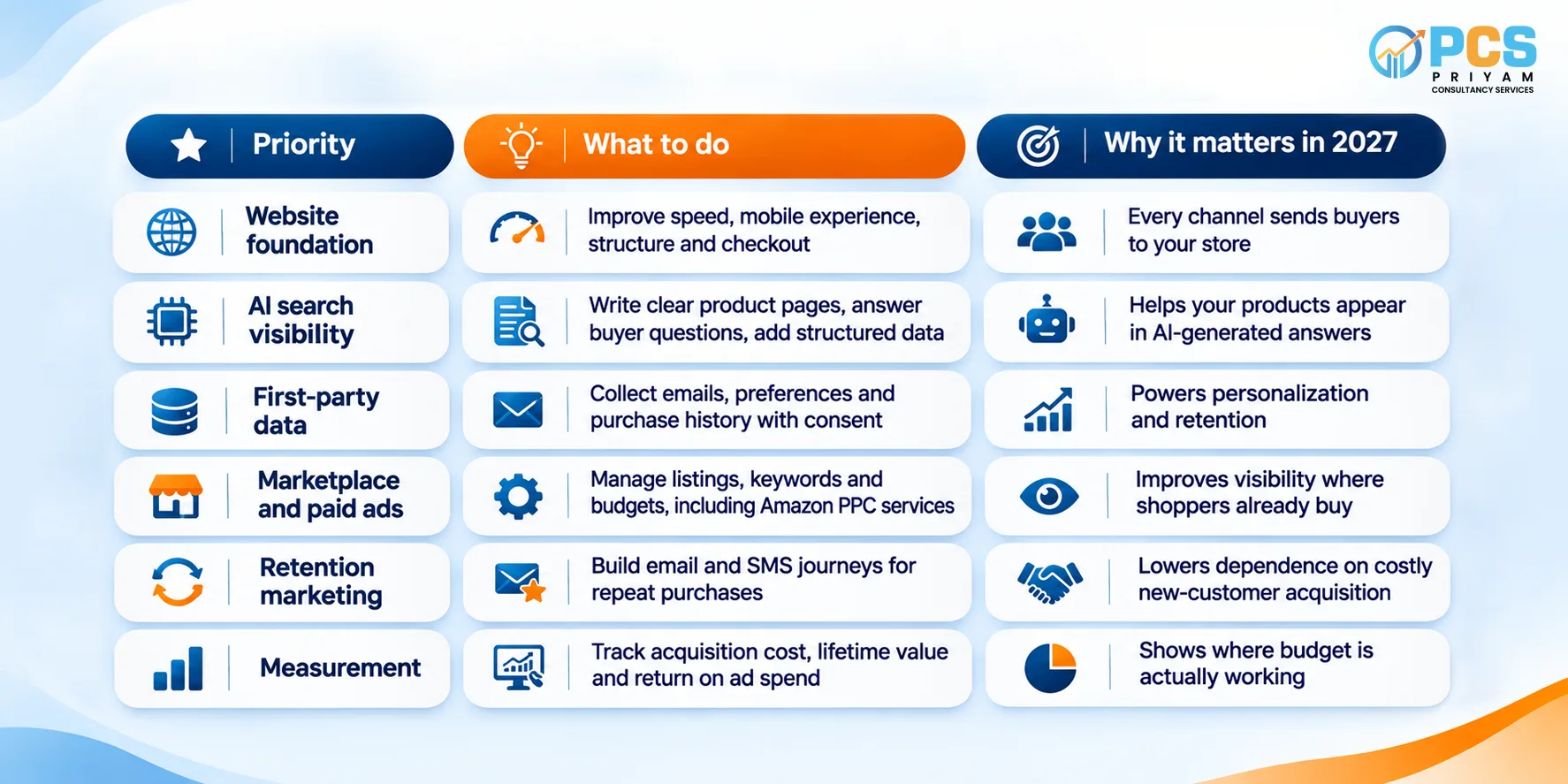
It starts with laying a solid foundation. This means having a speedy, responsive, well-structured store with a streamlined checkout process to make the experience seamless no matter what channel customers use. Rather than adhering to a general guideline on budgets, allocate funds where you need them most. If your store is lagging or the checkout is bleeding customers, make website development your priority. If you have a great store but lack traffic, prioritize marketing. For an ecommerce website development company in Coimbatore, choose one that develops stores with performance, SEO and tracking in mind.
Next, develop a comprehensive strategy for ecommerce digital marketing through SEO, social media, email, and marketplace marketing. Manage first party data carefully, experiment with AI-powered tools, and track relevant metrics. If you don’t have enough time and expertise, hire an ecommerce marketing agency to help you with ecommerce marketing services. A full-service ecommerce agency will be able to take care of both your store and your marketing needs.
Conclusion
The coming years in ecommerce marketing are going to be all about discoverability through AI search, being personal in your communication, being everywhere your customers may buy, and being focused on data and measurements. This change has started happening, and being prepared for it is going to give you a serious competitive edge.
If you are looking for professional help in building your ecommerce website and selling more online, then you should consider Priyam Consultancy Services.
Frequently Asked Questions