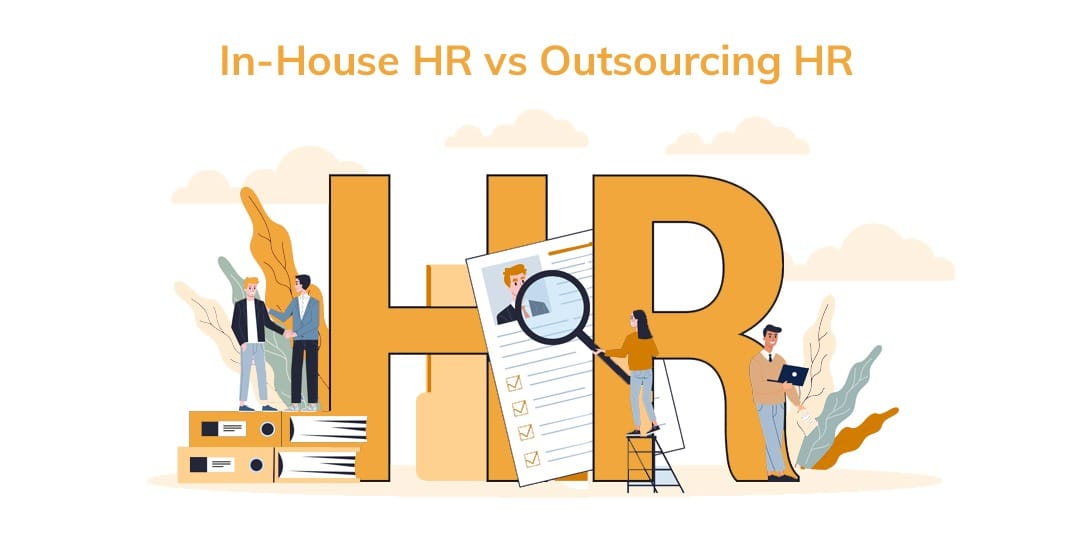
Managing multiple responsibilities such as marketing, sales, finance, and operations can be overwhelming for business owners—especially as teams grow. Among these, human resource management plays a critical role in shaping organizational success, covering everything from hiring and onboarding to payroll, compliance, and employee engagement.
When it comes to managing HR functions, businesses usually choose between two approaches:
- In-House HR, where an internal team handles all HR-related activities
- HR Outsourcing, where an external HR service provider manages HR responsibilities on behalf of the organization
Choosing the right HR structure isn’t a one-size-fits-all decision. Each model comes with its own advantages and challenges. The ideal choice depends on your business size, growth stage, compliance needs, budget, and long-term goals.
In this guide, we compare outsourcing HR vs in-house HR for business, helping Indian companies understand which approach delivers better control, cost efficiency, and scalability in 2026.
What is In-House HR?
In-house HR refers to building a dedicated internal HR team employed directly by the organization. This team is responsible for managing core HR functions such as recruitment, payroll coordination, employee relations, benefits administration, compliance tracking, and performance management.
Because in-house HR professionals work closely within the organization, they develop a deep understanding of company culture, internal processes, leadership expectations, and employee needs. However, effective in-house HR requires consistent investment in skilled professionals, tools, training, and compliance expertise.
What are the advantages of In-House HR?
An in-house HR department can be valuable for businesses that prioritize internal control and cultural alignment.
Key benefits include:
- Strong cultural alignment: Internal HR teams work closely with leadership, ensuring HR policies reflect company values and vision
- Faster communication & decision-making: On-site presence enables quick responses to employee issues and management decisions
- Greater control over HR processes: Organizations retain direct oversight of recruitment, engagement, and policy enforcement
- Stronger employee relationships: Face-to-face interaction builds trust, improves morale, and enhances employee satisfaction
Challenges of In-House HR
Despite its advantages, in-house HR also comes with limitations—especially for growing businesses.
Common challenges include:
- Higher operational costs: Salaries, benefits, HR software, training, and infrastructure add up quickly
- Limited specialized expertise: Internal teams may lack deep knowledge in areas like labor law updates, compliance audits, or benefits structuring
- Increased administrative burden: Managing end-to-end HR internally can distract leadership from core business growth
- Scalability issues: Smaller HR teams struggle during rapid hiring or expansion phases
- Compliance risks: Keeping up with frequently changing Indian labor laws increases the risk of penalties and errors
When is In-house HR the Best Choice?
In-house HR is often preferred by organizations that follow traditional business models and value tight internal control. When strict data privacy and security requirements are a priority, businesses rely on an In-House HR Department to manage sensitive employee information internally. Additionally, larger companies with the resources to hire, train, and maintain a full-scale HR team often choose In-house HR Services to ensure alignment with long-term operational goals.
What is HR Outsourcing?
HR Outsourcing involves assigning various HR services such as payroll processing, recruitment, compliance, and employee benefits administration by partnering with HR outsourcing providers, businesses can tap into specialized HR knowledge and industry best practices to manage HR functions more efficiently.
This approach not only offers cost savings, reduces overhead, but also reduces expenses caused by the In-house HR department. Outsourcing HR Service allows businesses to scale their HR operations based on evolving needs, while enabling internal teams to focus on core business activities and strategic initiatives.
Advantages of HR Outsourcing
For many Indian businesses, outsourcing HR offers a flexible and cost-effective alternative.
Key advantages include:
- Cost benefits of outsourcing HR vs in-house: Lower fixed costs compared to maintaining a full-time HR team
- Speed & reliability: Faster recruitment cycles, payroll processing, and issue resolution
- Expert compliance management: Dedicated specialists ensure adherence to PF, ESI, payroll, and labor laws
- Access to wider talent networks: Outsourced partners bring stronger hiring reach and screening capabilities
- Scalability & flexibility: HR services scale easily as the workforce grows or contracts
What are the Potential Challenges of HR Outsourcing?
While there are many advantages of Outsourcing HR, there are a few challenges to consider:
- Reduced Control & Visibility: Outsourcing HR services can limit a company’s direct oversight over processes like employee engagement.
- Limited Personalized HR Support: External providers may not fully understand your company culture, which can lead to a generic approach to HR management.
- Cultural Adaptation Delay: Outsourced HR providers may take time to understand and align with your company’s unique culture and values.
- Performance Insight Gaps: External HR teams may struggle to accurately assess internal employee performance due to limited day-to-day interaction.
This makes HR outsourcing particularly attractive for startups, SMEs, and fast-growing organizations.
Challenges of HR Outsourcing?
While there are many advantages of Outsourcing HR, there are a few challenges to consider:
- Reduced Control & Visibility: Outsourcing HR services can limit a company’s direct oversight over processes like employee engagement.
- Limited Personalized HR Support: External providers may not fully understand your company culture, which can lead to a generic approach to HR management.
- Cultural Adaptation Delay: Outsourced HR providers may take time to understand and align with your company’s unique culture and values.
- Performance Insight Gaps: External HR teams may struggle to accurately assess internal employee performance due to limited day-to-day interaction.
When is HR Outsourcing the Best Choice?
Outsourcing HR can be a smart move for companies of all size companies but it varies on company’s needs. Whether you’re a start-up, mid-sized firm, or an enterprise, outsourcing provides access to advanced technologies, domain expertise. It allows companies to stay compliant, enhance employee experiences, and streamline core HR functions without the overhead of managing everything internally.
For fast-growing businesses, outsourcing ensures HR scales alongside your workforce enabling faster on-boarding, smoother compliance, and reduced operational constraints.
Even large companies benefit by offloading repetitive, time-consuming administrative tasks. This empowers their in-house HR departments to focus on high-impact initiatives like talent strategy, leadership development, and workforce planning. At PCS, we help businesses unlock the full potential of HR outsourcing delivering not just service, but strategic support, operational efficiency, and seamless scalability.
Outsourcing HR vs In-House HR: Decision Table
When Should a Business Outsource Its HR?
HR outsourcing is ideal for businesses that:
- Are growing rapidly
- Operate in compliance-
- heavy industries
- Expand across multiple Indian states
- Lack internal HR expertise
- Want flexibility without long-term cost commitments
Even larger enterprises benefit by outsourcing repetitive administrative tasks, allowing internal teams to focus on talent strategy and leadership development.
Real-World Case: How Outsourced HR Enabled Business Readiness
A growing technology company faced significant HR challenges during its early expansion phase, including slow hiring cycles, delayed onboarding, inconsistent payroll execution, and a lack of structured HR policies and compliance readiness. With limited in-house HR bandwidth, recruitment turnaround times were high, payroll and payslip processing were frequently delayed, and statutory compliance under government norms posed a growing risk.
By outsourcing core HR functions—recruitment, payroll, compliance, and HR structuring—the company streamlined its hiring workflows and reduced onboarding time by up to 40%, enabling faster team scaling to meet project demands. Monthly payroll execution was stabilized with timely salary disbursements and accurate payslip management, while statutory requirements such as PF, ESI, and legal documentation were aligned to ensure compliance.
In parallel, the organization transitioned from an unstructured HR setup to a formalized framework with the implementation of HR policies, travel and expense guidelines, business conduct policies, and standard operating procedures (SOPs). This outsourced HR model removed operational bottlenecks, improved hiring speed and compliance reliability, and allowed leadership teams to focus on core business growth rather than administrative HR management.
Choose the Best HR Structure for Your Business
Every business has unique goals, growth patterns, workforce needs, and an HR structure that should reflect that.
Some companies benefit from a full-time in-house HR department, especially when they require day-to-day employee engagement, culture-building, and leadership visibility. However, managing HR internally also demands significant investment in hiring, compliance, systems, and training.
On the other hand, outsourcing HR offers a flexible and scalable alternative. It provides instant access to specialized expertise, integrated technologies, and strategic guidance that streamline operations, ensure compliance, and focus leadership time on growth and innovation.
For many growing organizations, a hybrid model combines an internal HR presence with external support for payroll, compliance, recruitment, or employee benefits.
At PCS, we help you assess your business needs and build the HR structure that fits — in-house, outsourced, or a combination of both. Our goal is to align HR with your business strategy and support your workforce at every growth stage.
Frequently Asked Questions