How AI is Changing Digital Marketing Forever
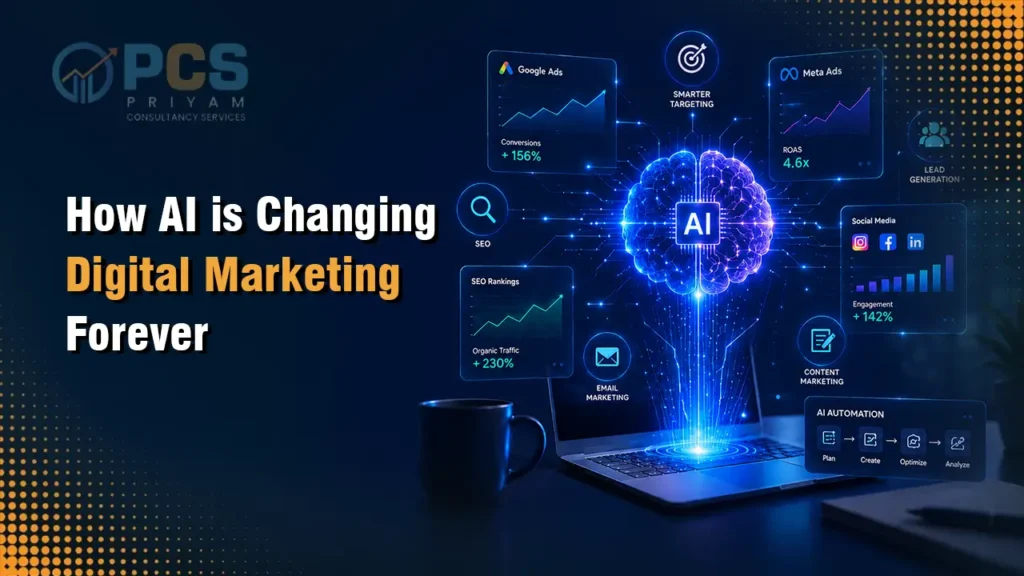
How AI is Changing Digital Marketing Forever If you’ve been running ads, posting content, and chasing leads without seeing consistent results, you’re not alone. Marketing today feels harder than it used to — costs keep rising, customers scroll past generic content, and it’s tough to know what’s actually working until it’s too late. At the same time, one word keeps coming up everywhere: AI. It’s in your ad platform, your email tool, even your competitor’s chatbot. But most business owners aren’t asking “what is AI” anymore — they’re asking whether AI in digital marketing actually solves real problems, or if it’s just another trend to keep up with.This blog breaks that down simply. No confusing tech talk — just what AI is really changing about digital marketing, why it matters for growing businesses, and how you can start using it without overhauling everything you already do. What Is AI in Digital Marketing? In simple terms, AI in digital marketing means using smart tools to handle the repetitive, data-heavy parts of marketing — so decisions get faster and more accurate, without needing a bigger team.Instead of manually guessing which ad performs better or spending hours analyzing spreadsheets, AI tools can: Study customer behavior and predict what they’re likely to respond to Generate and refine content in a fraction of the time Flag what’s working (and what isn’t) almost instantly It’s not about replacing how you think about your business — it’s about removing the slow, manual work that was never a good use of your time in the first place.To see how far this has come, it helps to look at two developments already shaping the direction marketing is heading in: agentic AI and emerging brain-response research. From Manual Guesswork to Automated Marketing Agentic AI doesn’t just respond to one prompt and stop — it takes a goal, breaks it into steps, acts on it, checks results, and adjusts, with far less step-by-step management needed from a person. In practice, a tool like Claude, connected through a workspace like Claude Cowork, can be set up to draft a blog post, turn it into a LinkedIn post and Instagram carousel, and pull in competitor research as part of one connected workflow — with a person setting the goal and reviewing the output along the way, rather than typing out each step manually. Worth mentioning separately: Meta FAIR recently released a research model called TRIBE v2. It’s important to be accurate about what this actually is — it’s a neuroscience model trained on fMRI brain scans from over 700 volunteers, built to predict how the brain responds to sights, sounds, and language, mainly for medical and cognitive research. It isn’t a marketing tool, and no major ad platform currently uses it for content scoring. That said, it points to something marketers have long worked with intuitively: simple language, a strong hook, a clear payoff, and a message that doesn’t feel like a hard sell all tend to perform better on fast-scrolling platforms like Instagram, because that’s genuinely how attention and comprehension work in the brain. TRIBE v2 doesn’t hand businesses a ready-made scoring tool today — but it’s an early sign that the science behind “why some content grabs attention and some doesn’t” is becoming more precise, and that’s likely to filter into marketing tools over time. Here’s how AI-driven automation — agentic AI, not TRIBE v2 — is already showing up across the channels most businesses use: Channel Before AI After AI Instagram Post and hope it performs; find out what worked days later Multiple captions/hooks tested quickly; best performer identified faster Meta Ads Manually build audiences, adjust budget after checking reports Advantage+ finds high-intent users; budget shifts in real time Google Ads Set keywords and bids manually, adjust weekly Performance Max automates bidding, reallocating spend as it learns Search (SEO) Guess topics, wait weeks to see if rankings move AI tools help discover high-intent keywords by analyzing search data, competition, and user intent The pattern is the same across all four: less guessing, faster feedback, and budget that moves toward what’s actually working. Why Are Businesses Spending More on Marketing but Getting Fewer Results? This is the frustration a lot of business owners quietly deal with. Ad costs keep climbing every year, yet leads and conversions don’t grow at the same rate. A few reasons why: More competition, same audience. Every business is fighting for the same attention online, which drives costs up. Generic content gets ignored. Customers can tell when messaging feels copy-pasted instead of relevant to them. Decisions are made too late. By the time a monthly report shows what went wrong, the budget’s already spent. Manual processes can’t keep up. Without automation, teams simply can’t test, adjust, and optimize fast enough.This is exactly the gap AI for digital marketing is closing — not by spending more, but by spending smarter. Here’s a simple way to picture it: if two businesses spend the same amount on ads, but one uses AI to identify high-intent customers while the other targets broadly and hopes for the best, the difference in results won’t stay small — it compounds month after month. Over a year, that gap often decides which business scales and which one plateaus. How to Use AI to Solve Everyday Marketing Challenges AI becomes useful the moment you apply it to a specific, everyday problem. Here’s how that plays out in practice:If your ad budget feels wasted, AI-driven targeting narrows your audience to people who are actually likely to convert, instead of showing your ad to everyone. If your team struggles to keep up with content demands, AI tools can draft blogs, captions, and ad copy in minutes, giving your team more time to refine and strategize instead of starting from a blank page. And if you’re unsure why a campaign underperformed, AI-powered analytics explain the “why” in real time — not three weeks later, once the budget’s already gone. The pattern is simple: AI doesn’t replace your strategy.
Shopify vs WooCommerce: A Complete Guide to Choosing the Best E-Commerce Platform

Shopify vs WooCommerce: A Complete Guide to Choosing the Best E-Commerce Platform Every online business starts with the same big question, and it’s rarely about products or pricing first — it’s Shopify vs WooCommerce. Get this decision right, and e-commerce website development feels smooth, scalable, and stress-free. Get it wrong, and you could be looking at a costly platform migration down the road. Shopify hands you a fully hosted, plug-and-play store that’s live in hours. WooCommerce, on the other hand, turns WordPress into a fully customisable selling machine, built exactly the way you want it. Neither is universally “better” — the right pick depends entirely on your budget, your technical comfort, and where you see your business a year from now. This guide breaks down both platforms so you can choose with confidence, not guesswork. Key Takeaways: Shopify vs WooCommerce Aspect Shopify WooCommerce Best for Fast, hassle-free launches Full control and customisation Technical Skill Needed Low Moderate to High Hosting Managed for you Self-managed Pricing Style Fixed monthly subscription Variable, pay-as-you-go Ideal Partner Shopify Website Design Expert WooCommerce Development Company Growth Path Great for standard stores Great for highly custom stores What is Shopify? An Overview for Shopify Website Design Shopify is a fully hosted e-commerce platform, which means the technical heavy lifting — servers, security, backups, and updates — is handled entirely by Shopify itself. You simply sign up, pick a theme, add products, and start selling. This makes it a favourite among entrepreneurs who want a store up and running quickly without hiring a developer for every small change. Shopify also has a huge app marketplace covering everything from marketing to inventory management, and its checkout is known for being fast and reliable, which directly helps conversion rates. For businesses that value speed, stability, and dedicated support, Shopify Website Design is often the more comfortable starting point, especially for founders who’d rather focus on products and marketing than server configuration. What is WooCommerce? A Look at WooCommerce Development WooCommerce is a free, open-source plugin that turns a WordPress website into a full online store. Unlike Shopify, it isn’t hosted for you — you’ll need your own hosting, and you’re responsible for updates and security, either yourself or through a development partner. What WooCommerce trades in convenience, it makes up for in flexibility. Since it’s built on WordPress, you get complete access to the code, thousands of plugins, and the freedom to customize almost anything, from checkout flow to product pages. This is exactly why many growing brands turn to a dedicated WooCommerce Development Company to build and maintain a store that truly fits their workflow, rather than piecing together hosting, plugins, and security settings on their own. Shopify vs WooCommerce: Feature Comparison at a Glance Feature Shopify WooCommerce Hosting Included, fully managed Self-hosted, you choose the provider Ease of Setup Very beginner-friendly Requires WordPress familiarity Customisation Good, within theme limits Extensive, near-unlimited Ongoing Maintenance Handled by Shopify Managed by you or a developer App/Plugin Ecosystem Large, curated marketplace Massive, open WordPress library Best Suited For Quick launches, non-technical owners Businesses wanting full control This table sums up the core trade-off nicely: Shopify prioritises simplicity, while WooCommerce prioritises freedom. Cost Breakdown: Shopify vs WooCommerce Pricing Pricing is often where businesses make their final call, so here’s a quick side-by-side. Figures below reflect published rates as of July 2026 — both platforms adjust pricing periodically, so treat this as an approximate one. Shopify costs typically include: Monthly subscription fees starting around ₹1,499/mo on Basic, ₹5,599/mo on Grow, ₹22,680/mo on Advanced, and from ₹1,75,000/mo on Plus (Spring ’26 pricing, billed yearly — always check Shopify’s site for current rates) Third-party payment gateway fees — Shopify Payments isn’t available in India, so every Indian merchant pays Shopify’s transaction fee on top of their gateway’s own charge (Razorpay, PayU, Cashfree, etc.). This runs from about 2% on Basic down to roughly 0.2–0.6% on higher plans, so the fee shrinks as you move up, but it never disappears entirely for Indian stores Premium themes and apps, if needed WooCommerce costs typically include: Hosting fees, roughly ₹300–₹3,000+ per month depending on traffic and server quality A domain name and SSL certificate, usually ₹1,000–₹2,000 per year combined Optional premium plugins or themes Developer costs, if you hire help for setup or ongoing changes The WooCommerce plugin itself is genuinely free, but that’s rarely the real cost driver — hosting, managed security, and developer time are, and for a growing store these can add up to roughly the same monthly spend as a comparable Shopify plan. So “free” describes the software, not the total cost of running the store. Which Platform Should You Choose for E Commerce Website Development? There’s no single right answer here; it genuinely depends on your business needs. Choose Shopify if you want a store to live quickly, prefer predictable monthly pricing, and don’t want to manage technical infrastructure. Choose WooCommerce if you already use WordPress, need deep customisation, or plan to scale into a highly specific workflow. Choose a hybrid approach if you’re unsure — some businesses start on Shopify to validate an idea quickly, then move to WooCommerce once they need more control. Whichever direction you lean, the platform is only half the story — good e commerce website development also depends on design, speed, and reliable support. Scalability and Security: Planning for Long-Term Growth Your platform choice today should also hold up as your business grows. Shopify scales smoothly because it manages server capacity, PCI-DSS compliance, and security patches behind the scenes, so a traffic spike during a big sale rarely causes downtime. WooCommerce can scale just as well, but the responsibility shifts to you — a robust hosting plan, regular backups, and timely plugin updates keep the store secure and fast as order volumes climb. Neither approach is weaker; Shopify bakes scalability into the price, while WooCommerce lets you scale on your own terms, provided maintenance stays on track. Why Partner with a Professional Website Development Company Even
How to Choose the Best Digital Marketing Company in Coimbatore

How to Choose the Best Digital Marketing Company in Coimbatore Coimbatore is rapidly becoming one of Tamil Nadu’s most competitive digital business markets. From textile manufacturers to IT startups, from educational institutions to retail brands — every business in the city is fighting for the same online attention. And in that fight, your choice of digital marketing company in Coimbatore will either accelerate your growth or quietly drain your budget with nothing to show for it. Most guides tell you to check portfolios and ask for case studies. That advice is not wrong — but it is incomplete. The best agencies are being separated from the rest by something most business owners are not even asking about yet: how they use AI, how they track real results, and whether their strategy actually changes based on your industry.This guide covers what others don’t. Why Your Choice of Digital Marketing Partner Matters More Than You Think Most business owners treat choosing a digital marketing company in Coimbatore the same way they would buy office stationery — they look for the cheapest option and move on. That approach is expensive in the long run. The wrong agency costs you more than their monthly retainer. It costs you time — months of poor strategy and weak execution. It costs you an opportunity — competitors who choose the right partner are ranking, generating leads, and closing deals while you wait for results that never arrive. And it costs you credibility — inconsistent social media, poor content, and zero ROI damage your brand in ways that take years to repair. The right partner functions as a growth engine — one that measures success the same way you do: enquiries, revenue, and return on every rupee invested. Coimbatore delivers approximately 7% of Tamil Nadu’s total GDP and has one of the most diverse business ecosystems in South India. In this environment, your digital marketing partner is not a vendor. They are a strategic asset. Define Your Goals Before You Start Looking The single biggest mistake Coimbatore businesses make when searching for a digital marketing company is starting with the agency instead of starting with themselves. Before you speak to a single agency, get clear on what you actually want: Leads and enquiries — you need SEO, pay-per-click marketing, and landing page optimisation Brand awareness — you need social media marketing and content marketing Online sales —you need ecommerce website development and a performance marketing strategy B2B client acquisition—you need B2B digital marketing, LinkedIn marketing, and targeted pay per click services Search rankings—you need an SEO company in Coimbatore with a proven technical and content strategy Why does this matter? Because different agencies specialise in different outcomes. A digital marketing agency in Coimbatore that is exceptional at social media marketing may have no expertise in enterprise SEO consulting or B2B digital marketing. A PPC company in Coimbatore that runs excellent Google Ads campaigns may have no content team. When you walk in with clear goals, you can evaluate whether an agency’s actual capabilities match what you need — instead of being sold on a generic service package that sounds comprehensive but delivers nothing specific. Key Services to Look for in a Digital Marketing Company in Coimbatore A full-service digital marketing company in Coimbatore should offer a core set of capabilities that work together as an integrated system — not isolated services sold separately. Here is what to look for: Search Engine Optimisation (SEO) An SEO company in Coimbatore should offer both on-page and technical SEO, local SEO for Coimbatore-specific searches, and content-driven authority building. For larger businesses, enterprise SEO consulting covers site architecture, international targeting, and large-scale content strategy. Pay-Per-Click Marketing and Paid Ads A competent PPC company in Coimbatore manages Google Search Ads, Display Ads, Shopping Ads, and Meta Ads — with transparent reporting on cost per lead, ROAS, and campaign performance. Pay per click services should always come with clear budget accountability, not vague “ad spend management” language. Social Media Marketing in Coimbatore Instagram, Facebook, LinkedIn, and YouTube — the right agency creates platform-specific strategies, not the same content posted everywhere. For Coimbatore businesses, social media marketing should factor in regional audience behaviour, Tamil-language content opportunities, and local competitor activity. Ecommerce Website Development Coimbatore If you sell products online, an ecommerce website is a foundational requirement before any marketing investment. A poorly built e-commerce website will waste every rupee you spend on ads and SEO. B2B Digital Marketing For manufacturers, industrial suppliers, and service businesses targeting other businesses, B2B digital marketing requires a completely different strategy — longer sales cycles, LinkedIn lead generation, account-based marketing, and content that speaks to procurement and decision-maker audiences. Content Marketing and Website Development Every sustainable digital marketing service package should include content creation — blogs, videos, infographics — and a well-built, fast-loading website that converts the traffic your campaigns generate. How to Evaluate a Digital Marketing Agency’s Track Record and Credibility Any agency can make promises. What separates the best digital marketing company in Coimbatore from the rest is verifiable proof of results. Here is how to evaluate credibility before you sign anything:How do you use AI and automation in your campaigns? This is the most important question most Coimbatore businesses are not asking yet. The best agencies in 2025 are using AI tools for keyword research, content analysis, ad copy testing, audience segmentation, and performance prediction. Agencies that are not adopting these capabilities are already falling behind — and your campaigns will reflect that gap. Ask specifically: which AI tools do you use? How do they improve results? What do you now do faster and more accurately because of automation? How do you measure results — not deliverables? This is where most agencies reveal themselves. An agency focused on deliverables will say: “We post 20 times a month, write 4 blogs, run 3 ad campaigns.” An agency focused on results will say: “We target a cost per lead of X, we track keyword movement weekly, and we