Think about the last time you bought something. Chances are, you did not walk into a store. For a growing number of purchase decisions — especially in categories like electronics, fashion, and home goods — the journey begins and often ends online. That shift is accelerating, and businesses that ignore it are losing customers they never even knew were considering them.
And yet, a large number of product-based businesses particularly in cities like Coimbatore are still operating without an online presence. Many have no websites, while others have a basic page that displays their products but does nothing to bring customers in. Many have taken their first steps through online marketplaces like Amazon and Flipkart, or through social commerce platforms like Meesho — particularly useful for small sellers in fashion and everyday essentials. But very few have built the kind of ecommerce website that actually drives consistent, scalable revenue.
And if you already have a website that only displays your products without any buying functionality, it is time to understand why that is costing you customers every single day — and what a performance-driven ecommerce website development company in Coimbatore can do to change that.
What Genuine Ecommerce Development Services Actually Cover
There is a significant difference between building a website and building an ecommerce business. A successful online store is more than a storefront—it is a complete system designed to support sales, operations, and growth.
Genuine ecommerce development services begin with understanding the business model, target audience, product catalog, and fulfilment process. These insights shape the store’s structure, user experience, and scalability.
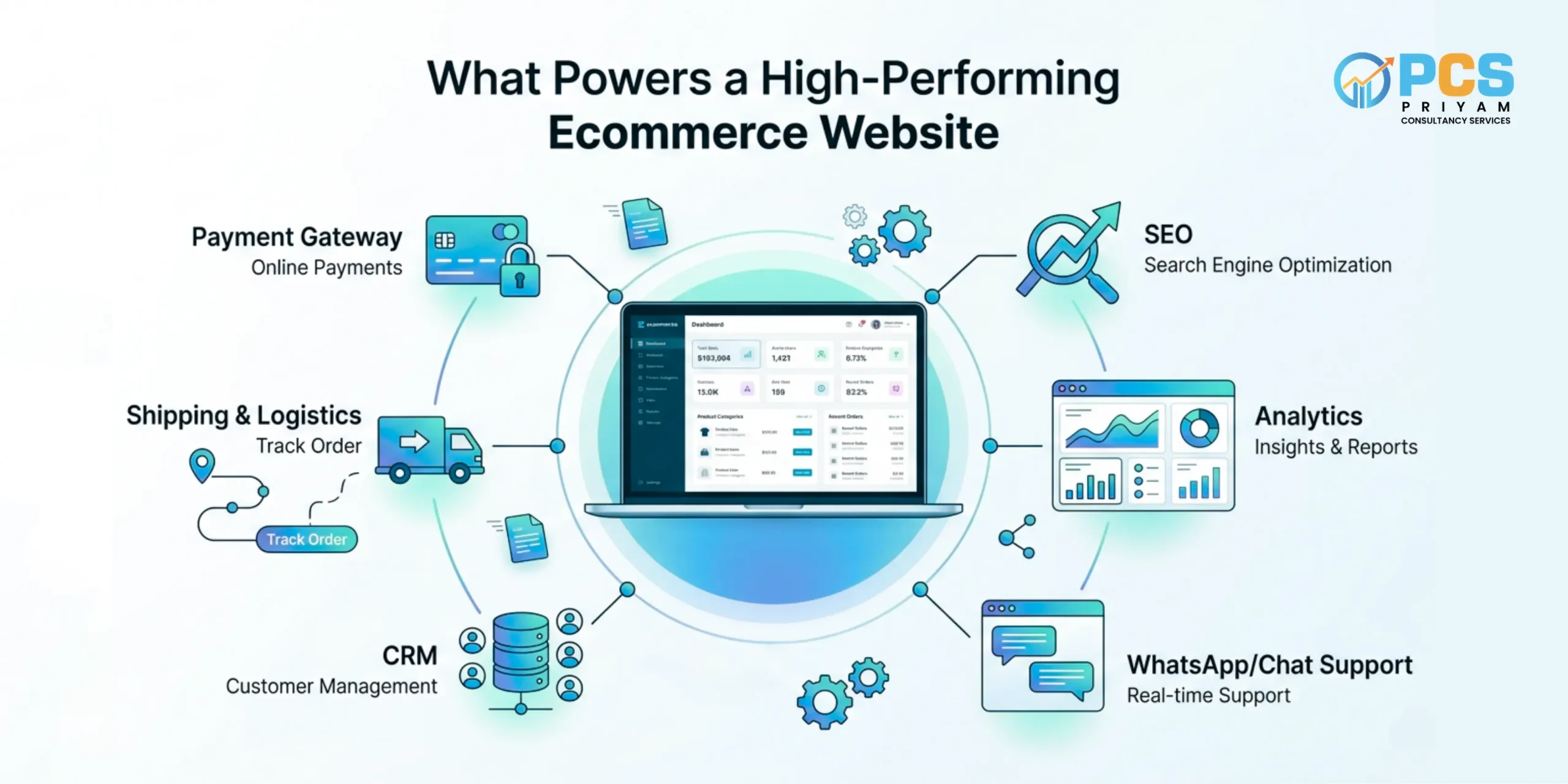
Beyond design and development, ecommerce services typically include:
- Ecommerce platform setup
- Payment gateway integration
- Shipping and logistics integration
- CRM and customer communication tools
- Analytics and performance tracking
- SEO-friendly website architecture
Industry expertise also plays a crucial role. An ecommerce store for a textile business will require a different customer journey and marketing strategy than one selling skincare products or industrial equipment.
Most importantly, ecommerce development does not end at launch. Ongoing maintenance, SEO improvements, performance optimization, and feature updates are essential for long-term success.
In simple terms, genuine ecommerce development services focus on building a complete online business—not just a website.
The Problem With Display-Only Websites
Many businesses in Coimbatore have taken the step of building a website — but not the kind that drives revenue. These are websites that display products, list contact details, and perhaps describe services, but have no mechanism for a customer to actually purchase anything. They are nothing more than digital brochures.
A display-only website does serve a limited purpose. It establishes that the business exists online and gives potential customers a place to find basic information. However, it does very little to generate revenue — and it solves none of the problems that a proper ecommerce website addresses.
Consider what a display-only website cannot do. It misses the customer at the exact moment they are ready to buy. It cannot process a transaction at midnight when the office is closed. It has no way to follow up automatically with a customer who browsed a product but did not enquire. It offers no personalization recommendations based on browsing behaviour. And it gives the business no visibility into which products are generating genuine interest and which are being consistently ignored.
In short, a display-only website asks the customer to do all the work — to take the information they have found and then make a separate effort to contact, enquire, and eventually purchase. In a world where Amazon and Flipkart offer rapid delivery and one-tap checkout, that friction is fatal to conversion.
Research consistently shows that friction in the purchase path significantly reduces conversion — and a display-only website is friction at its most fundamental. It asks the customer to do all the work at the exact moment they are ready to buy. Without proper SEO strategies, structured metadata, and quality content built into the page architecture, a website — however well designed — will not appear in search results when potential customers are actively looking for what you sell. Good product photography and clean layout are necessary, but they are not sufficient on their own. Visibility requires a deliberate technical and content strategy woven into the website from the ground up.
A display-only website is not a halfway solution. It is a missed opportunity — one that costs the business customers every single day without ever making the loss visible.
What a Performance-Driven Ecommerce Website Actually Requires
Building an ecommerce website that genuinely performs is a fundamentally different exercise from building a display website. It requires deliberate decisions across multiple layers — each of which affects the others and collectively determines whether the store generates revenue or simply occupies a URL.
Platform Selection — WooCommerce, Shopify, or Custom Ecommerce Development
The first and most consequential decision is platform selection. There is no single right answer, but there is absolutely a right answer for each specific business — and getting it wrong creates expensive problems later.
WooCommerce — is the right choice for businesses that need deep flexibility and complete control. It is open source and highly customisable, making it ideal for businesses with complex product catalogues, variable pricing structures, bulk ordering requirements, or the need to integrate tightly with existing inventory or ERP systems. Manufacturers, wholesalers, and businesses with a large number of product variants consistently benefit from WooCommerce’s configurability. Because the business owns the platform entirely, there are no recurring platform licensing fees — though hosting, premium plugins, security, and ongoing maintenance do involve real costs that should be factored into the decision.
Shopify —is better suited for direct-to-consumer brands that prioritise speed to market and ease of ongoing management. It handles hosting, platform-level security including PCI compliance, and software updates automatically — removing significant technical overhead from the business. For lifestyle brands, consumer product companies, and businesses that want to focus primarily on marketing and customer experience rather than managing technical infrastructure, Shopify offers a polished, stable foundation that is difficult to match for speed and simplicity. Its ecosystem of apps and integrations also makes it straightforward to add functionality as the business grows.
Custom ecommerce development —is the right path when neither WooCommerce nor Shopify can accommodate the business model without significant compromise. This includes businesses with unique checkout logic, multi-vendor marketplace requirements, subscription-based commerce, or deep integrations with legacy business systems. Custom builds require more time and investment upfront, and demand ongoing technical resources to maintain and scale — but they eliminate the constraints and workarounds that come with adapting a business to fit a platform’s limitations, and they grow precisely in line with the business’s actual needs.
Choosing the right platform is, therefore, not a technical decision. It is a business decision — and it should be made by a development partner who understands the implications of each choice for operations, scalability, and long-term cost of ownership.
Industry-Specific Design and Targeting
Beyond platform selection, a performance-driven ecommerce website design must reflect the specific industry and the specific buyer it is built for. This means the visual design, product presentation, navigation structure, and keyword strategy should all be tailored to the customer who will actually use the store — not applied generically across business types.
A B2B engineering components supplier in Coimbatore needs bulk ordering tables, technical specifications, and a checkout designed for purchase orders. A D2C food brand needs storytelling-led product pages, trust signals, and a seamless mobile checkout. The same template applied to both will underserve both. Industry expertise in ecommerce development is what ensures the store is built for its actual audience — and that the SEO strategies target the specific search terms that the audience uses when they are ready to buy.
Operational Integrations and Analytics
A performance-driven ecommerce store also needs the operational infrastructure to function as a real business. Payment gateways, logistics platforms, automated customer communication, CRM tools, and reporting dashboards must all be connected and configured correctly from the start.
Equally important is the analytics layer. Google Analytics, Google Tag Manager, Google Search Console, and behavioural tools like Microsoft Clarity must be set up correctly at launch — because without accurate data, every optimisation decision is a guess. SEO strategies embedded into the site architecture from day one ensure that organic traffic builds over time, progressively reducing dependence on paid advertising and lowering the cost of every customer acquired.
Case Study — Feral Roots: From Brand Foundation to a Fully Operational Digital Business
Feral Roots is a natural and sustainable products brand that needed far more than just a storefront. They needed an entire digital business infrastructure built from scratch — one where the brand identity, the online store, the logistics, and the marketing all worked together as a single coordinated system. The engagement began not with design, but with an in-depth brand study. Understanding the brand’s positioning, its target audience, and what those customers expected from an online shopping experience shaped every decision that followed — from the visual identity of the store to the content of each product page to the channels used for customer acquisition.
The development phase covered every operational layer a real business needs to function. A secure payment gateway was integrated for smooth transactions. WhatsApp was connected for instant customer communication. Shiprocket was set up for end-to-end courier management and live order tracking. Automated email sequences kept customers informed throughout their journey. A CRM was implemented to manage relationships systematically, and custom dashboards were built so the team could monitor orders, revenue, and performance in one place. On the discoverability side, SEO architecture was embedded from the ground up — covering technical foundations like site speed, mobile optimisation, and structured data markup, alongside URL architecture, metadata, and content strategy aligned to how the target audience actually searches. Google Analytics, Google Tag Manager, Microsoft Clarity, Google Search Console, and Bing Webmaster Tools were all configured at launch — ensuring the store was visible, trackable, and optimisation-ready from day one.
Within weeks of launch, Feral Roots was fully operational — receiving customers, processing orders, managing fulfilment, and tracking performance across every channel through a single coordinated system. Every integration worked from day one, eliminating the delays and disconnected tools that typically follow a website launch. Social media promotion and local business optimisation through review and reputation management further extended the brand’s credibility across every digital touchpoint. Not a website that needed months of additional work. A complete, coordinated system where every element reinforced every other. That is what professional ecommerce development services produce when strategy drives the work from the very beginning.
Conclusion: The Right Path — Marketplace First, Ecommerce Website Next, Growth Always
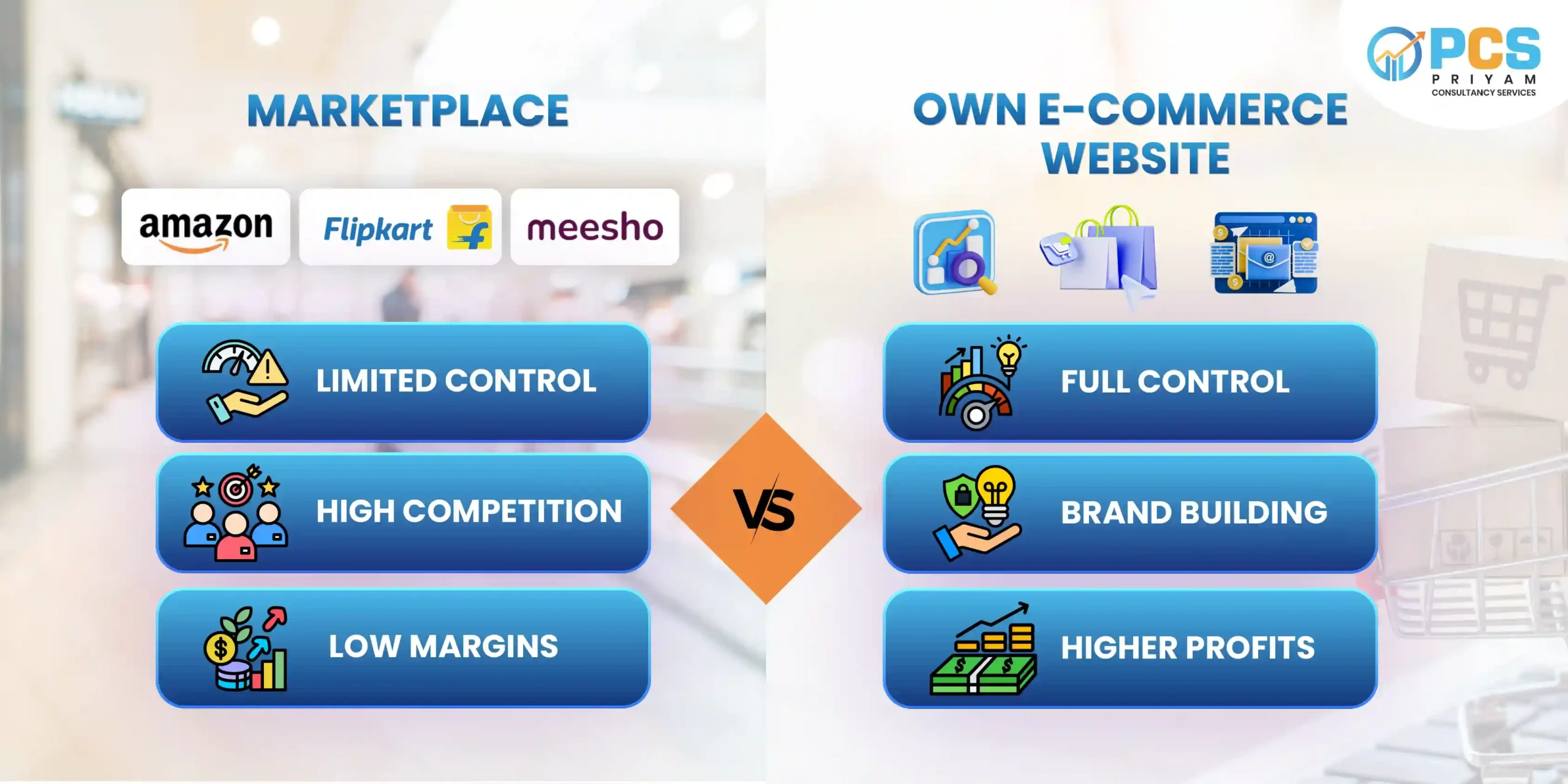
If you are a business owner just beginning your ecommerce journey, the path forward is clearer than it might feel. Start with marketplaces. Use Amazon, Flipkart, or Meesho to validate demand, understand your customers, and build initial sales momentum in an environment that handles logistics, payments, and discovery for you. It is the lowest-risk, fastest way to test whether your products have online demand.
But as your business grows, do not stay there. The limitations of marketplace dependency — no customer ownership, constant pricing pressure, zero brand differentiation, and complete vulnerability to platform algorithm changes — become increasingly costly over time. The natural and necessary next step is an ecommerce website that you own entirely. One built with the right platform for your business model, industry-specific design and targeting, proper SEO strategies that build organic traffic over time, and the operational integrations that allow you to scale without operational chaos.
And if you already have a display-only website, understand that it is not a foundation to build on — it is a gap to close. Customers who find a product they want and cannot buy it immediately will not call you. They will buy from someone else.
The difference between an ecommerce business that grows and one that stagnates almost always comes down to one thing: the quality of the foundation it was built on. Get that right from the start, and everything built on top of it compounds. Get it wrong, and every fix costs more than it would have to build correctly the first time.
Priyam Consultancy Services helps businesses at every stage of this journey — from first ecommerce website builds to full-scale custom ecommerce development, across industries, with the platform expertise across WooCommerce and Shopify, the strategic process, and the long-term commitment that ecommerce success actually requires.