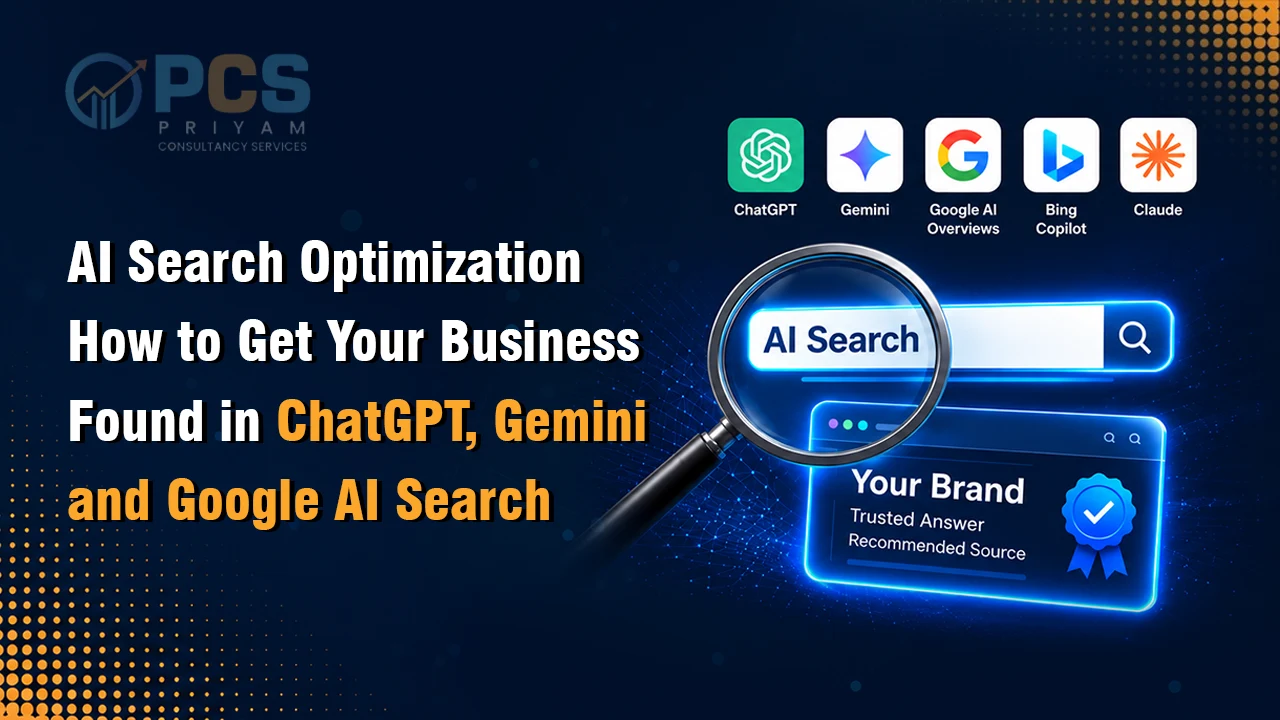
Search no longer ends with a list of blue links. When someone asks ChatGPT, Gemini, or Google’s AI Overviews a question today, they often get a complete answer — with your competitor’s business named as the source, not yours.
Google’s AI search surfaces are already operating at a massive scale. Google reported at its 2026 I/O keynote that AI Overviews had surpassed 2.5 billion monthly active users, while AI Mode — its conversational search experience — passed 1 billion monthly users within its first year. The implication for businesses is clear: ranking in the traditional blue-link results is no longer the only visibility objective. AI search optimization is what determines whether your business actually gets named inside that answer.
Key Takeaways
-
-
- AI search optimization decides whether your business gets cited inside an AI-generated answer — strong organic SEO helps, but it doesn’t guarantee citation.
- ChatGPT rewards domain authority and consensus across sources; traditional rankings don’t fully predict whether it cites you.
- Google AI Overviews favor pages with answer-first structure and topical authority beyond the main keyword.
- For local businesses, Gemini visibility can be influenced by the strength and consistency of your Google ecosystem presence, including your Business Profile, website, and reviews.
- No single platform covers all AI search traffic — a strategy built around only ChatGPT or only Google leaves real visibility on the table.
- AI citation is inconsistent even for strong brands — only 30% maintain visibility across sessions, so this requires ongoing tracking, not a one-time fix.
What Is AI Search Optimization and How Is It Different From Traditional SEO?
AI search optimization is the practice of structuring your website and content so AI platforms — ChatGPT, Gemini, Perplexity, and Google’s AI Overviews — can understand, trust, and cite your business when generating an answer.
Traditional SEO targets ranking position in a list of links. AI search optimization targets something different: being selected as a source inside a synthesized answer. Research from the Princeton-led GEO study found that adding statistics, quotations, and credible source citations can increase the visibility of content in generative-engine responses. More recent research also suggests that structured, evidence-rich pages are more likely to be cited or have their information absorbed into AI-generated answers. Keyword placement alone doesn’t carry the same weight it once did.
AI SEO vs. Generative Engine Optimization (GEO): Are They the Same Thing?
They overlap, but they aren’t necessarily identical. GEO has a specific research lineage and generally refers to optimizing for generative engines — ChatGPT, Perplexity, Gemini, Claude — that synthesize an answer. “AI SEO” is a broader industry term that can include AI-assisted traditional SEO, AEO (Answer Engine Optimization, which originally referred to voice assistants like Alexa and Siri), GEO, entity optimization, and related practices.
The practical distinction that matters most: GEO rewards authority, structure, and answer quality over keyword density. Teams that apply pure, old-school SEO tactics to AI search tend to underperform, because the underlying ranking signals aren’t the same.
How to Rank in ChatGPT: What Actually Gets Your Business Cited
ChatGPT currently dominates measurable AI referral traffic, although the exact share varies substantially by dataset, geography, and measurement period — 2026 studies have generally placed its share above 80% in the datasets they measured. That makes it one of the most important platforms to get right when learning how to rank in ChatGPT — or simply how to get found in ChatGPT as a business. A few things make the difference:
- Domain authority matters more than on Google.Research from SE Ranking found sites with over 32,000 referring domains are 3.5x more likely to be cited by ChatGPT — AI models appear to use the link graph as a trust signal.
- Consensus across sources counts.ChatGPT is designed to minimize inaccurate answers by checking agreement across multiple sources, so being one of several sites saying the same verifiable thing helps more than being the only one.
- Don’t assume Google rank transfers. ChatGPT Search often cites pages ranking at position 21+ in traditional Google results — meaning strong Google rankings don’t guarantee ChatGPT visibility, and vice versa.
Google AI Search Optimization: Getting Found in AI Overviews
Google AI search optimization starts with understanding that Google AI Overviews are grounded in Google’s search ecosystem, so strong organic SEO remains an important foundation. However, ranking on page one is not a prerequisite for every AI Overview citation — a Surfer study of 10,000 keywords found that roughly 68% of cited pages did not rank in Google’s top 10 for either the main query or its related “fan-out” queries. Pages already earning featured snippets are, however, significantly more likely to get cited, since Google has already flagged them as strong answer sources.
- Answer-first paragraphs — AI Overviews favor the page with the cleanest, most directly usable answer, not necessarily the page with the strongest overall ranking signals.
- Topical authority beyond the main keyword — a Surfer study of 10,000 keywords found pages ranking for a topic’s related “fan-out” queries were 161% more likely to be cited in AI Overviews.
- Structured, extractable content — clear headers, direct answers near the top, and content organized around real user questions.
What Gemini and Other AI Engines Look For Before Recommending a Business
Gemini behaves differently from both ChatGPT and Google AI Overviews because it is tied into Google’s broader ecosystem rather than functioning as an independent index. For local businesses, Gemini visibility can be influenced by the strength and consistency of your Google ecosystem presence, including your Business Profile, website, reviews, and other local signals — though the exact weighting Google applies isn’t publicly documented.
The broader lesson across all AI engines: no single platform captures all AI search traffic, and optimizing for only one — usually ChatGPT, since it dominates referral volume — leaves real visibility on the table with Google’s AI layer and Gemini.
How to Optimize for AI Search: A Practical Action Checklist
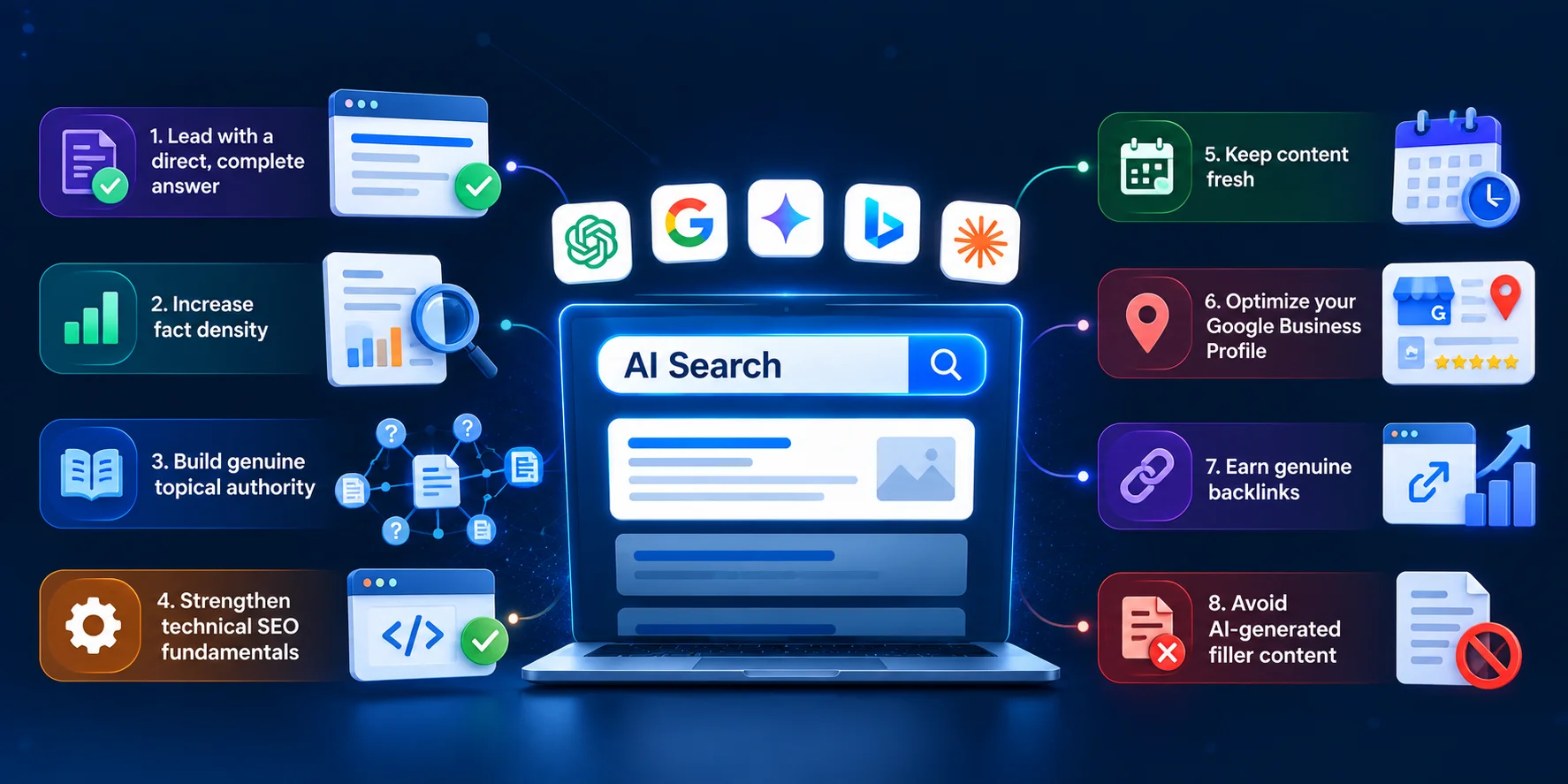
- Lead with a direct, complete answer in the first 1-2 sentences of any page targeting a specific question.
- Increase fact density — specific numbers, named sources, and verifiable claims, not vague generalizations.
- Build genuine topical authority —cover a topic’s related questions, not just the primary keyword.
- Strengthen technical SEO fundamentals — if Google can’t crawl your site cleanly, AI systems struggle to trust it too.
- Keep content fresh —AI-cited content is measurably fresher than typical organic content; stale pages lose citation share over time.
- Optimize your Google Business Profile — critical for Gemini and local AI search visibility specifically.
- Earn genuine backlinks — domain authority remains a strong trust signal, particularly for ChatGPT.
- Avoid AI-generated filler content — both Google and AI systems are increasingly effective at detecting low-quality, low-fact-density content, and it actively hurts citation odds.
Measuring AI Search Visibility: How Do You Know If It's Working?
This is genuinely difficult right now — there’s no AI equivalent of checking your Google rank. Most businesses track AI search visibility by manually querying ChatGPT, Gemini, and Google AI Overviews with relevant customer questions and recording whether and how they’re cited, alongside which competitors appear instead.
A more sophisticated approach tracks several distinct signals rather than just “cited or not,” since citation selection and actual influence inside the answer appear to be different things:
- Brand mention — does your business get named at all, even without a link?
- Citation — are you linked as a source?
- Citation position/prominence — where does your citation appear in the answer?
- Competitor mentions — who else is showing up alongside or instead of you?
- Share of AI answers — across a set of relevant queries, how often do you appear versus competitors?
- Referral traffic and conversion rate — is AI citation actually translating into visits and enquiries?
- Cross-session consistency — does your visibility hold up across repeated queries over time?
Worth knowing before you judge results too quickly: even strong brands don’t get cited consistently. Research tracking 45,000 citations found only 30% of brands maintain consistent AI search visibility from one session to the next. Inconsistent citation isn’t necessarily a sign something’s wrong — it’s closer to the current norm.
From Ranking to Being Recommended: The Bigger Shift
It helps to separate what’s actually being optimized for at each stage:
- Traditional SEO — the goal is to rank the page.
- AI Search / GEO — the goal is to become a trusted, retrievable, and citable source.
- AI Recommendation — the goal is to have your brand included in the answer or shortlist.
- Business Outcome — the goal is qualified traffic, enquiries, and conversions.
Each stage builds on the one before it, but succeeding at one doesn’t automatically guarantee the next.
Conclusion
AI search optimization isn’t a future consideration — it’s already determining which businesses get named when a customer asks ChatGPT, Gemini, or Google a question instead of typing it into a search bar. The businesses getting cited aren’t necessarily the ones ranking #1 on Google; they’re the ones with clear, evidence-rich, well-structured content and genuine authority behind it, built platform by platform rather than through one generic strategy.
At Priyam Consultancy Services (PCS), we help businesses evaluate where they currently stand across these platforms and build toward genuine AI search visibility.
Frequently Asked Questions