
AI Search Optimization: How to Get Your Business Found in ChatGPT, Gemini and Google AI Search Search no longer ends...

Most of the practices below — mobile-first design, fast load times, accessibility, and continuous testing — have been core UX disciplines for several years. What makes 2026 different is the layer being added on top: AI agents, generative interfaces, and privacy-first personalization are now reshaping how these fundamentals are applied.
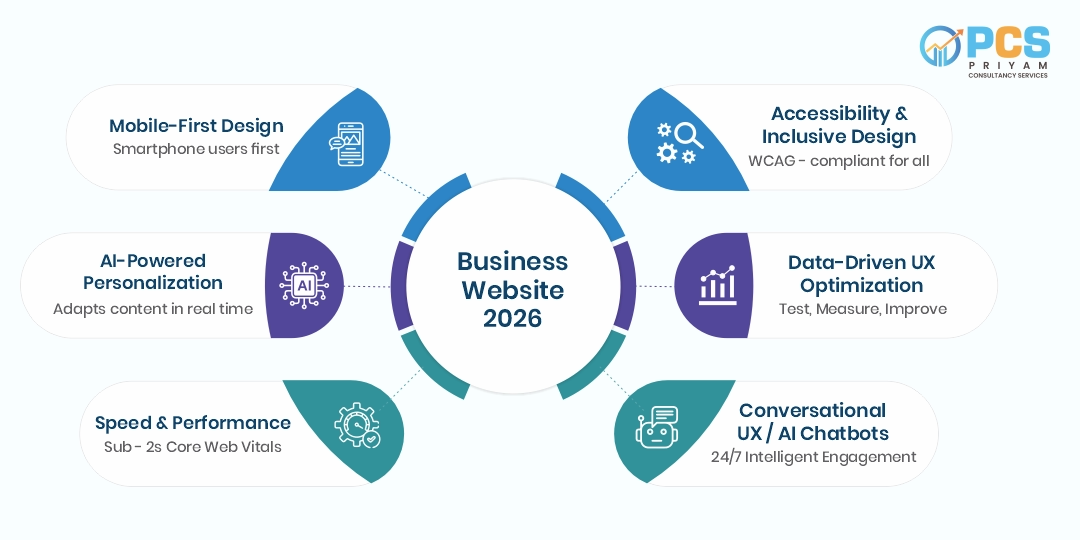
| UX Trend | What It Does | Business Impact |
|---|---|---|
| AI-Powered Personalization | Adapts content to each visitor in real time | Higher engagement, lower bounce rate |
| Mobile-First Design | Optimizes for smartphone users first | Captures 60%+ of web traffic |
| Speed & Core Web Vitals | Ensures fast load times across devices | Better rankings, more conversions |
| Conversational UX / AI Chatbots | 24/7 intelligent query resolution | Reduced support costs, instant leads |
| Accessibility & Inclusive Design | WCAG-compliant, usable by all | Wider audience, reduced legal risk |
| Data-Driven UX Optimization | Continuous testing and refinement | Compounding CRO improvement |
Gone are the days of one-size-fits-all websites. Today’s visitors expect your site to recognize them — their intent, their stage in the journey, and what they actually care about. AI-powered personalization makes that happen in real time, without manual effort.
Imagine a first-time visitor landing on your homepage versus a returning customer who has already viewed your pricing page. With AI, both see a completely different experience — different headlines, different CTAs, different recommended content. That level of relevance is what drives conversions in 2026.
What is powering this shift:
AI-powered personalization is no longer an enterprise luxury. Mid-size businesses are now deploying it affordably — and it is one of the most measurable UX trends 2026 has delivered.
Personalization is not about knowing your customer’s name. It is about knowing what they need before they ask.
One second. That is all it takes to lose 7% of your conversions. Speed is not a backend problem — it is a UX problem, a revenue problem, and in 2026, a rankings problem too.
Google’s Core Web Vitals are non-negotiable ranking signals. Here is what your site needs to hit:
| Metric | What It Measures | Target |
|---|---|---|
| LCP (Largest Contentful Paint) | How fast main content loads | Under 2.5 sec |
| INP (Interaction to Next Paint) | How fast and smoothly the page responds across an entire visit | Under 200ms |
| CLS (Cumulative Layout Shift) | How stable the layout is while loading | Below 0.1 |
Miss these benchmarks and you are not just losing rankings — you are telling visitors your brand does not value their time. Fast websites build trust before a single word is read.
Speed is the first UX impression your website makes. Make it count.
The practical fixes are well known — next-gen image formats, CDN delivery, eliminating render-blocking scripts — but what separates the leaders in 2026 is treating performance as a continuous discipline, not a one-time launch checklist item.
Think about the last time you visited a website and a contact form was the only way to get an answer. Frustrating, right? That experience is becoming extinct — and conversational UX is replacing it.
In 2026, AI chatbots for websites are not the clunky pop-ups of 2019. They are intelligent, context-aware assistants that qualify leads, answer product questions, book appointments, and even close sales — all without a human in the loop.
Why businesses are investing heavily in conversational UX right now:
1.3 billion people worldwide live with some form of disability. If your website is not accessible, you are not just failing a legal standard — you are turning away a massive segment of potential customers.
Accessibility is no longer a compliance box to tick. In 2026, it is a business website UX trend with real commercial impact. WCAG 2.2 compliance is becoming a regulatory requirement in major markets, and Google rewards accessible, semantic HTML with better crawlability and rankings.
The good news? Accessibility improvements almost always improve the experience for everyone — not just users with disabilities.
A few non-negotiables for 2026:
An accessible website is not a stripped-down website. Done right, it is a cleaner, faster, and more intuitive experience for every single visitor.
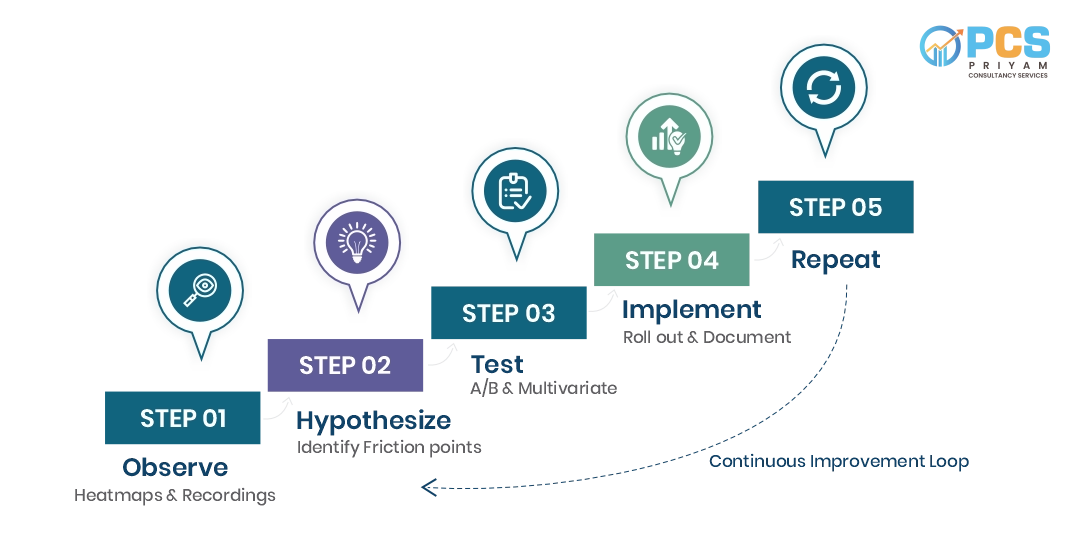
Step 4 — Implement: Roll out the winning variation. Document what you learned.
This approach turns your website into a compounding asset. Every cycle makes it more aligned with what your users actually want — and that alignment is what drives long-term business growth.

The six trends that matter most right now are AI-powered personalization, mobile-first design, website speed and Core Web Vitals, conversational UX through AI chatbots, accessibility and inclusive design, and data-driven UX optimization. You do not need to tackle all six at once — start with the area causing the most friction for your users and build from there.
AI personalization works by analyzing visitor behavior — such as referral source, pages viewed, time spent, and past interactions — and dynamically adapting the content they see. This can mean different headlines, product recommendations, or CTAs for different visitors. Tools like machine learning engines and behavioral analytics platforms make this possible even for mid-size businesses, not just large enterprises.
Yes — even if your current analytics show more desktop visits, Google indexes and ranks your website based on its mobile version first. A poor mobile experience directly hurts your search rankings and turns away a growing segment of users. Mobile-first design also tends to produce cleaner, faster, and more focused experiences across all devices.
A regular chatbot follows a fixed script and gives pre-set answers. Conversational UX is a broader design philosophy where your entire website guides users through a natural, dialogue-like experience — and AI chatbots in 2026 are a key part of that. Modern AI chatbots understand context, remember what a user asked earlier in the conversation, qualify leads intelligently, and escalate to a human only when truly needed.
Clear signals include a high bounce rate, low time on page, low conversion rates, poor Core Web Vitals scores, and user feedback pointing to confusion or difficulty navigating. Tools like Google Search Console, Hotjar heatmaps, and session recordings will show you exactly where users are dropping off — giving you a clear starting point for optimization.
PCS specializes in designing and optimizing business websites that are built around real user behavior and current UX best practices. Whether you need a full website redesign, speed optimization, AI chatbot integration, or ongoing data-driven UX improvements, PCS can guide you from strategy through execution — so your website becomes a consistent driver of business growth.

AI Search Optimization: How to Get Your Business Found in ChatGPT, Gemini and Google AI Search Search no longer ends...
WordPress: How AI Is Transforming Website Development and Management WordPress AI website development has moved from a collection of third-party...

HR Consulting Services: What Growing Businesses Actually Need Most founders don’t think about HR until something forces them to —...