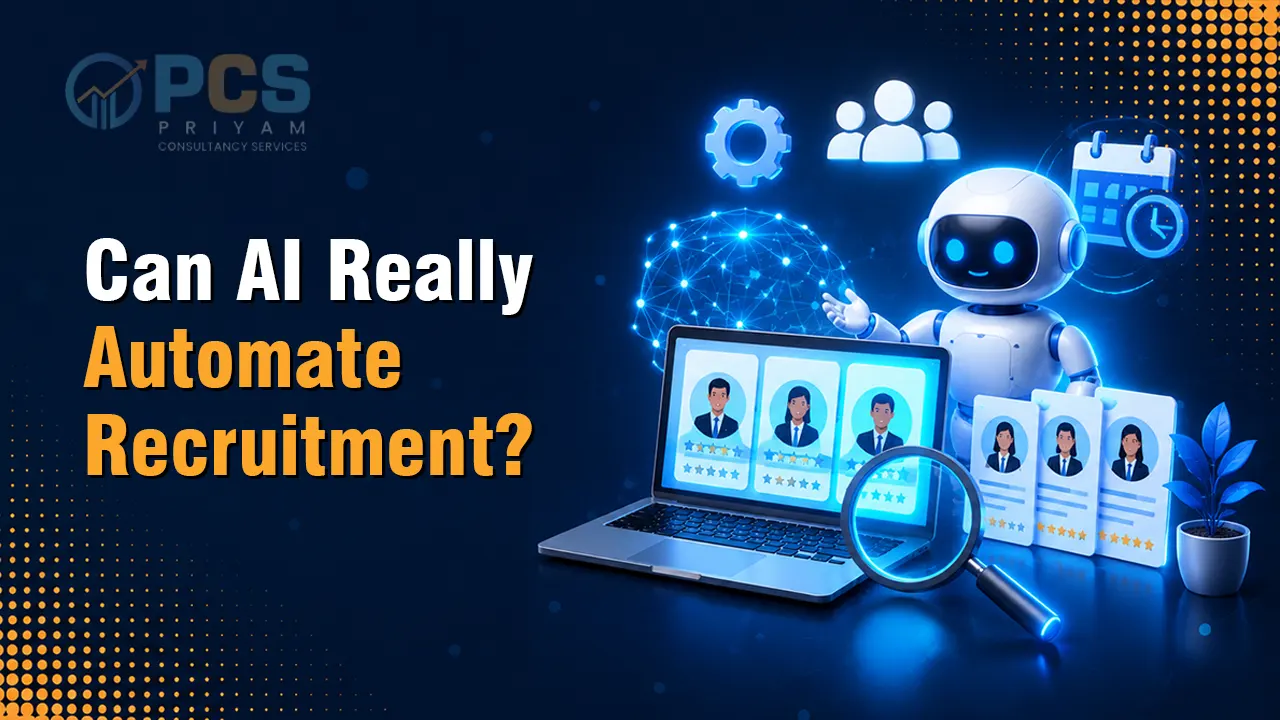
If you’ve been reading about AI in recruiting lately, you’ve probably seen bold claims about AI agents “running” the entire hiring process — sourcing, screening, scheduling, even decision-making. AI in recruitment and AI + HR automation are two of the most talked-about topics in HR circles right now, and it sounds impressive — but it also raises an honest question: is any of this actually true, or is it mostly hype?
The reality in 2026 is more nuanced than either extreme. AI is increasingly automating significant parts of recruitment that used to consume hours every week — but there are also parts of hiring that remain firmly, and rightly, in human hands.
This blog breaks down exactly where that line sits today — what AI agents can realistically automate, how mature interview scheduling actually is, where AI still falls short, and what businesses risk if they push automation too far.
Key Takeaways
Agentic AI can run multi-step recruitment tasks with less manual input — sourcing, screening, and scheduling — but that’s different from AI running the entire hiring process unsupervised.
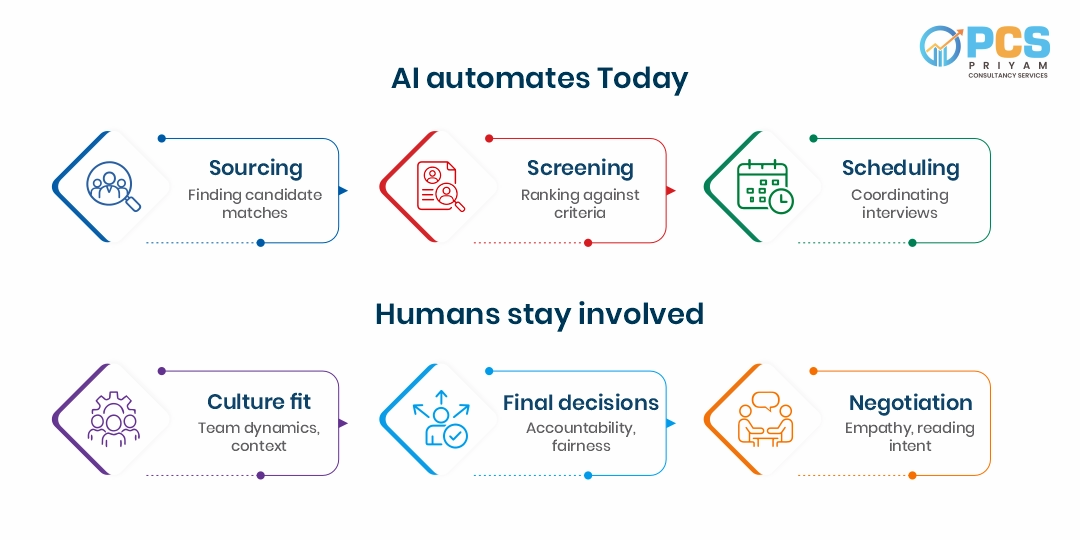
Sourcing, screening, and matching are where AI delivers the most value today, cutting hours of repetitive, low-judgment work.
Interview scheduling is one of the most mature areas of recruitment automation — but even top tools still need human fallback in roughly 1 in 5 cases.
Culture fit, final hiring decisions, and negotiation still require human judgment, and candidate trust in AI-only decisions remains low.
Ungoverned automation carries measurable risk — most companies already let AI reject candidates without human review, even while admitting they’re worried about bias.
The right approach isn’t full automation — it’s being deliberate about where AI-assisted hiring decisions help, and where a person needs to stay involved.
Agentic AI vs. Basic Automation: What's Actually Being Claimed
Most people picture two extremes when they hear “AI recruiting” — either a chatbot that suggests a resume, or a fully autonomous system making hiring decisions with no humans involved. Neither is accurate.
The real shift in AI in recruitment process work is what’s called agentic AI. Unlike basic automation, which follows a fixed rule (“if resume contains keyword X, shortlist it”), agentic AI can take a goal, break it into steps, act on those steps, check the results, and adjust — all with far less manual input from a person. Instead of one tool doing one task, it’s closer to a small system handling a connected workflow: sourcing candidates, ranking them, and flagging the strongest matches for review.
That’s the distinction worth understanding before anything else: AI recruiting tools today aren’t just faster spreadsheets — they’re part of a broader shift toward digital HR and HR technology, where multi-step parts of the process run largely on their own, with a person reviewing the output rather than performing each step manually.
How AI Agents Are Improving AI in Recruitment — Sourcing, Screening & Matching
This is where AI has made the most visible difference. Recruiters have traditionally spent enormous amounts of time on repetitive, high-volume tasks — and this is exactly where AI agents perform best. It’s also part of a broader move toward skills-first hiring, where candidates are evaluated on actual capability rather than degrees or job titles alone.
- Sourcing:
Depending on the tools and integrations available, AI can search candidate databases, job platforms, and other permitted sources to identify potential matches based on skills and experience — useful for both high-volume roles and targeted, niche recruitment where the right match matters more than the number of applicants. The exact reach depends heavily on which platforms and data sources a given system is actually connected to.
- Screening:
Instead of manually reading hundreds of resumes, AI can rank and shortlist candidates against predefined, job-relevant criteria in minutes.
- Matching:
AI compares candidate profiles against role requirements more consistently than manual review, reducing the chances of a strong candidate getting missed simply because a resume was skimmed too quickly.
For businesses evaluating AI recruiting companies or tools, this is usually the first and most valuable place automation gets applied — it removes hours of low-judgment work without touching the decisions that actually require a person.
Can AI Automate Interview Scheduling? Here's What Actually Works
Agentic AI vs. Basic Automation: What's Actually Being Claimed
Scheduling has long been one of recruitment’s most frustrating bottlenecks — endless email threads trying to find a time that works for everyone. This is one of the most mature and reliable areas of recruitment automation today.
AI scheduling tools can check calendar availability, coordinate interview times, send invitations and reminders, and handle many routine rescheduling requests with minimal recruiter involvement. For high-volume hiring in particular, this alone can save several hours a week that used to go entirely into back-and-forth coordination.
But “mature” isn’t the same as “solved.” Even leading agentic scheduling platforms report around 80% autonomous resolution — meaning roughly 1 in 5 scheduling cases still needs a person, especially for multi-timezone panels, last-minute interviewer changes, or conflicting preferences. Enterprise reschedule rates still run in the 14–15% range, and for global teams, a single reschedule in a multi-timezone panel can undo the coordination effort entirely. Adoption is also uneven industry-wide: most talent acquisition teams have adopted AI in some form, but only a small share have production-ready, fully agentic scheduling systems — many are still stuck piloting tools that haven’t scaled past the experiment phase. The practical takeaway: build in a human fallback, because a scheduling error — like a senior candidate showing up to an empty video call — is exactly the kind of mistake that’s cheap to prevent and expensive to explain.
Where AI in recruitment Still Falls Short — Judgment, Culture Fit & Final Decisions
This is the part that often gets glossed over in AI recruiting marketing. There are parts of hiring AI simply isn’t built to handle well:
- Culture and team fit:
AI can help structure behavioural evidence against defined, job-relevant criteria, but it cannot reliably determine interpersonal chemistry, team dynamics, or whether a candidate will genuinely thrive in a particular environment. Those judgments require human context — and because “culture fit” is itself a subjective and bias-prone concept, it works best when grounded in consistent, job-relevant criteria rather than gut feel alone.
- Final hiring decisions:
Human involvement in final hiring decisions remains important, particularly where the decision involves context, accountability, fairness, and candidate experience. Candidate sentiment here is genuinely mixed — some research shows a majority of applicants would prefer an AI-only interview stage when given the choice, while separate research points to real concerns around transparency, detachment, and accountability once AI is involved in the actual decision. The honest picture is nuanced, not settled.
- Negotiation and offer conversations:
These require empathy, reading intent, and judgment calls that go well beyond pattern matching.
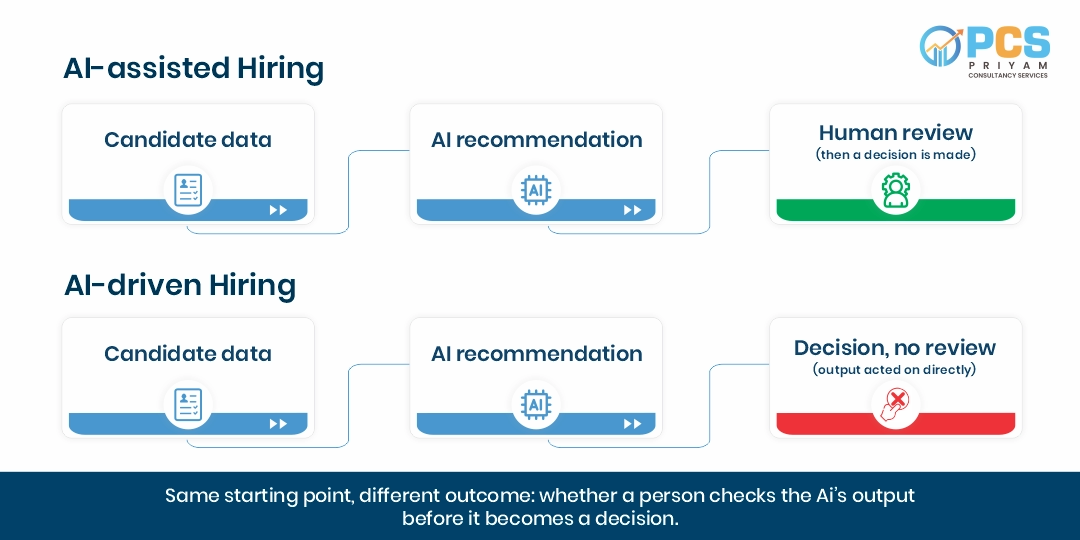
AI can support these decisions with data, but it shouldn’t be making them alone. This is the difference between AI-assisted hiring decisions — where AI informs a person’s judgment — and AI-driven decisions, where no one reviews the output. The businesses getting the best results treat AI as a tool that clears the repetitive work off a recruiter’s plate — not a replacement for the recruiter’s judgment.
The Risks of Letting AI Run Too Much
Pushing automation too far carries real, measurable risk — not just a missed opportunity.
Poorly governed AI systems can introduce or amplify bias through historical hiring data, proxy variables, model design, or inappropriate selection criteria. Even when an AI system is technically consistent, consistently applying flawed criteria produces consistently flawed outcomes. This isn’t a fringe concern: a large share of companies using AI in hiring say they worry it screens out qualified candidates or introduces bias — yet a majority of those same companies still let AI reject candidates with no human review at all. On the candidate’s side, roughly half of U.S. job seekers report receiving at least one AI-driven rejection with zero human feedback in the past year, and most were never even told AI was involved in the decision.
Candidate trust matters just as much as the compliance question. Research from Pew found a strong majority of Americans oppose letting AI make the final hiring call outright, and a comparable share say they wouldn’t even apply to a company that uses AI in its hiring decisions. Separately, a large 2026 survey of job seekers found only about a quarter trust AI to evaluate them fairly. Trust clearly hasn’t caught up with adoption — and that gap can affect how candidates perceive your brand as an employer, regardless of how efficient your process looks internally.
On the legal side, requirements aren’t universal — they depend on jurisdiction and use case. Depending on where and how a system is used, AI hiring tools may be subject to requirements around transparency, human oversight, data governance, bias mitigation, and documentation. Several regions now classify AI systems used for recruitment and candidate ranking as high-risk and require human oversight, while existing employment-discrimination protections in other regions continue to apply regardless of whether a human or an algorithm made the call. The direction of travel across regulators is consistent, even if the specific rules vary: toward human accountability, not away from it.
So, Can AI Run Recruitment on Its Own? Our Honest Verdict
Not entirely — and that’s not a limitation so much as how it should be. AI has genuinely taken over the repetitive, high-volume parts of recruitment: sourcing, screening, and scheduling are largely automated today, freeing up real time that used to disappear into admin work. But the parts of hiring that involve judgment — culture fit, final decisions, negotiation — are still, and should remain, human.
The businesses getting the most value from AI in 2026 aren’t the ones automating everything. They’re the ones being deliberate about where AI helps and where a person needs to stay in the room.
Conclusion
This is exactly the balance Priyam Consultancy Services brings to every recruitment engagement — using AI where it genuinely helps, for tasks like resume screening and candidate shortlisting, while keeping culture fit assessment and final hiring decisions in human hands, where judgment actually matters. As an HR consultancy in Coimbatore serving businesses across the region, we help companies combine practical AI tools with sound recruitment fundamentals — whether that’s evaluating AI recruiting tools for your specific hiring needs, providing full HR services in Coimbatore to manage the process end-to-end, or supporting RPO (recruitment process outsourcing) for businesses that want their entire hiring function handled externally. If you’re comparing recruitment agencies in Coimbatore for the first time, we’re happy to walk you through what’s genuinely worth automating — and what isn’t.
Frequently Asked Questions