Your brand can rank on page one of Google and still never appear in a ChatGPT, Perplexity, or Google AI Overviews answer. More people now ask AI tools for recommendations before they ever open a search results page, so being a source those tools cite has become a visibility channel.
This raises an important question about backlinks in AI search . Do they still matter? Do brand mentions matter more? And what does it take to build authority that AI systems can trust ? This guide covers how AI search optimization works, what is known and still uncertain, and how to improve your AI search visibility step by step.
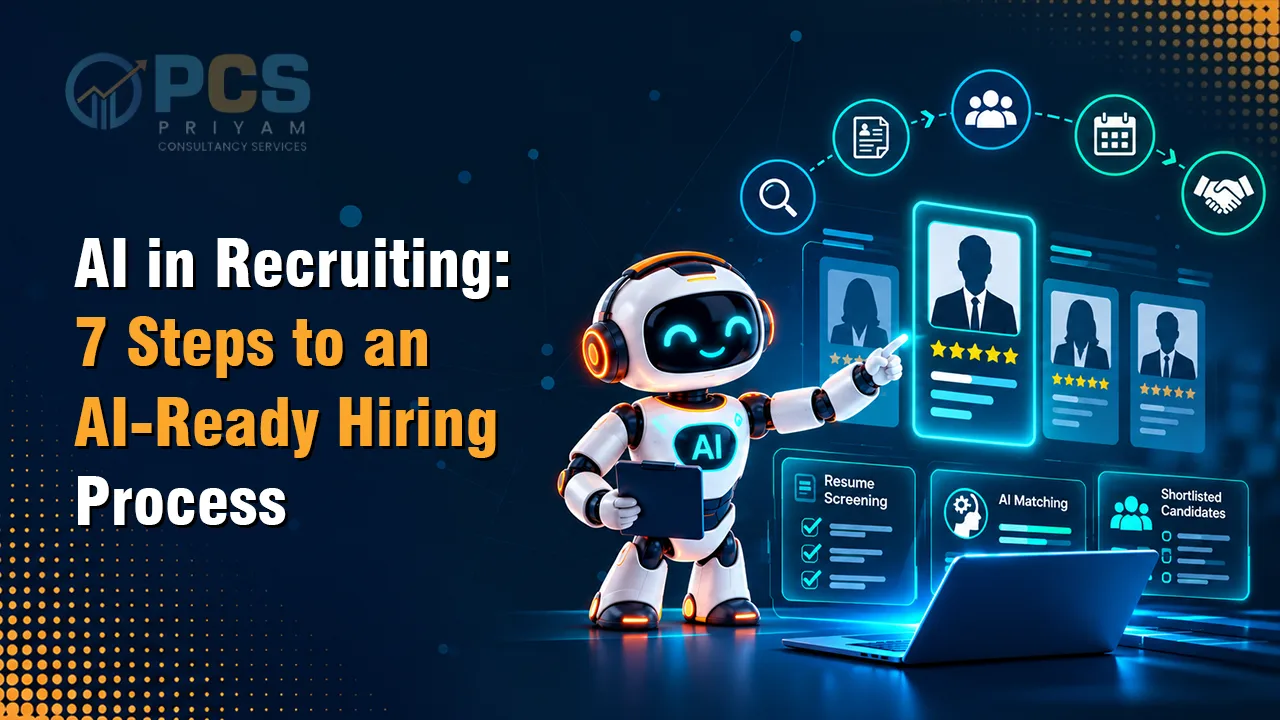
A smart AI hiring process faces these problems head-on. It mixes the technology with clear hiring goals, trained recruiters and results that can be measured. This blog shows seven steps to help HR teams and business owners make hiring much more efficient, fair and accurate.
Key Takeaways
-
-
- Backlinks still matter in AI search, mainly because they can support discovery and traditional search visibility. Links do not guarantee indexing, and links alone do not determine credibility. This happens before an AI system even thinks about using your content. Without backlinks, your pages may have fewer chances to be discovered, although links alone do not determine credibility. Even if there’s no link, AI models can connect your brand to a topic. These mentions build recognition and signal relevance. They may help AI systems associate your brand with a topic.
- Relevant, helpful content may be selected, but quality alone does not guarantee a citation. Does your page offer insight? Is it backed by expertise? Is it well organized and easy to understand? AI models look for these qualities. Quality alone does not guarantee a citation.
- The best AI SEO strategy uses all three: backlinks, brand mentions and authoritative content. Each one plays a role in how AI sees your site.
- To measure how well your content shows up in AI don’t just look at rankings. Track citations. See how often your brand appears in AI-generated answers. Check traffic. Watch for conversions. These are the signs of visibility.
Do Backlinks Still Matter for AI Search Visibility?
Backlinks still matter although their influence varies by platform and retrieval method for AI search visibility. The way they matter has changed. Many AI search tools use a retrieval system that looks at a web index and ranking methods. Pages with strong, relevant backlink profiles may rank more competitively, which increases their opportunities to be found and cited. A backlink can act as a signal of endorsement from another website, though not every link is an endorsement . Help discover pages but they do not guarantee citations.
A backlink can act as a signal of endorsement from another website . In traditional search, backlinks are one of many factors that can influence rankings. In AI search, they may play an indirect role by supporting a page’s discoverability and search performance.
The exact formulas that search engines and AI use are not public so we cannot know how much each backlink counts. Still, ignoring backlinks is risky, because pages that perform well in organic search may also be easier for some AI search tools to find.
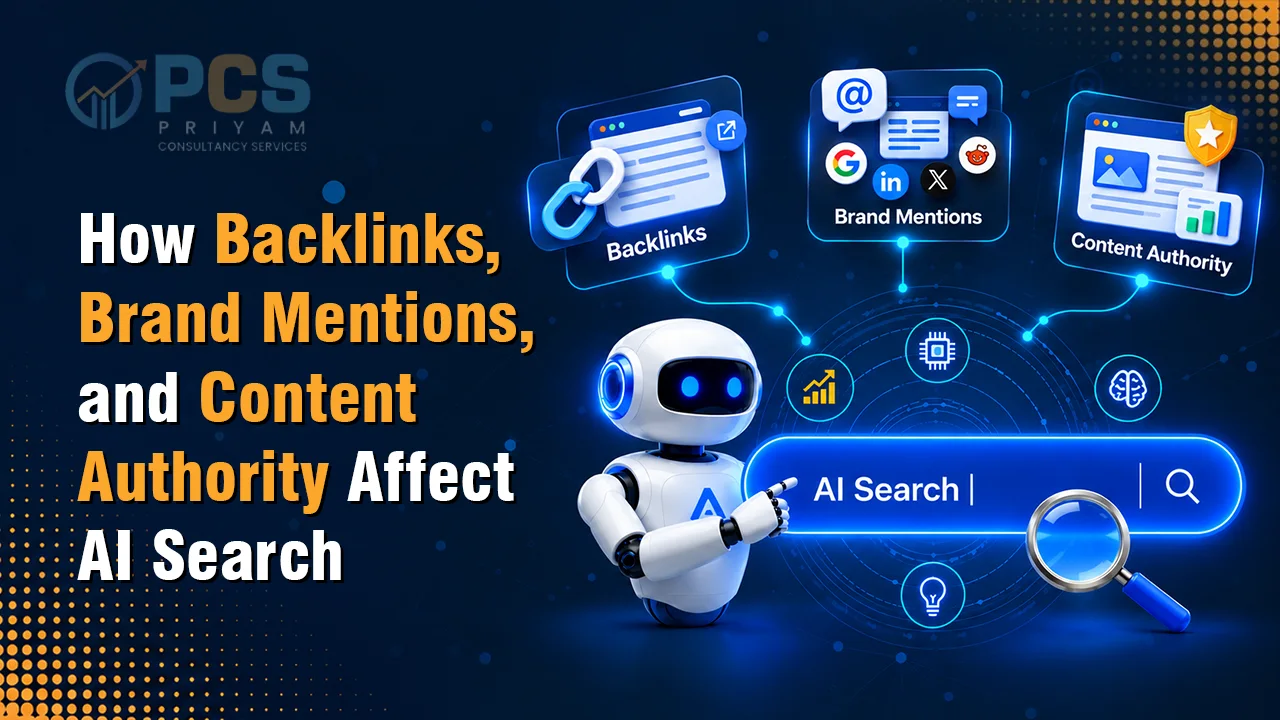
Understanding Backlinks, Brand Mentions, and Content Authority
Clarifying the three pillars before building a strategy is useful.
Backlinks are links from websites that point back to your site. If a link comes from an industry publication it shows that your content is worthy of being cited. The quality, relevance and authority of the linking site are more important than how many links you have.
Brand mentions are references to your brand on websites, whether or not they include a link . You can find mentions in news articles, reviews, Reddit discussions, podcasts, social media posts and other community conversations. They may help AI systems associate your brand with specific topics.
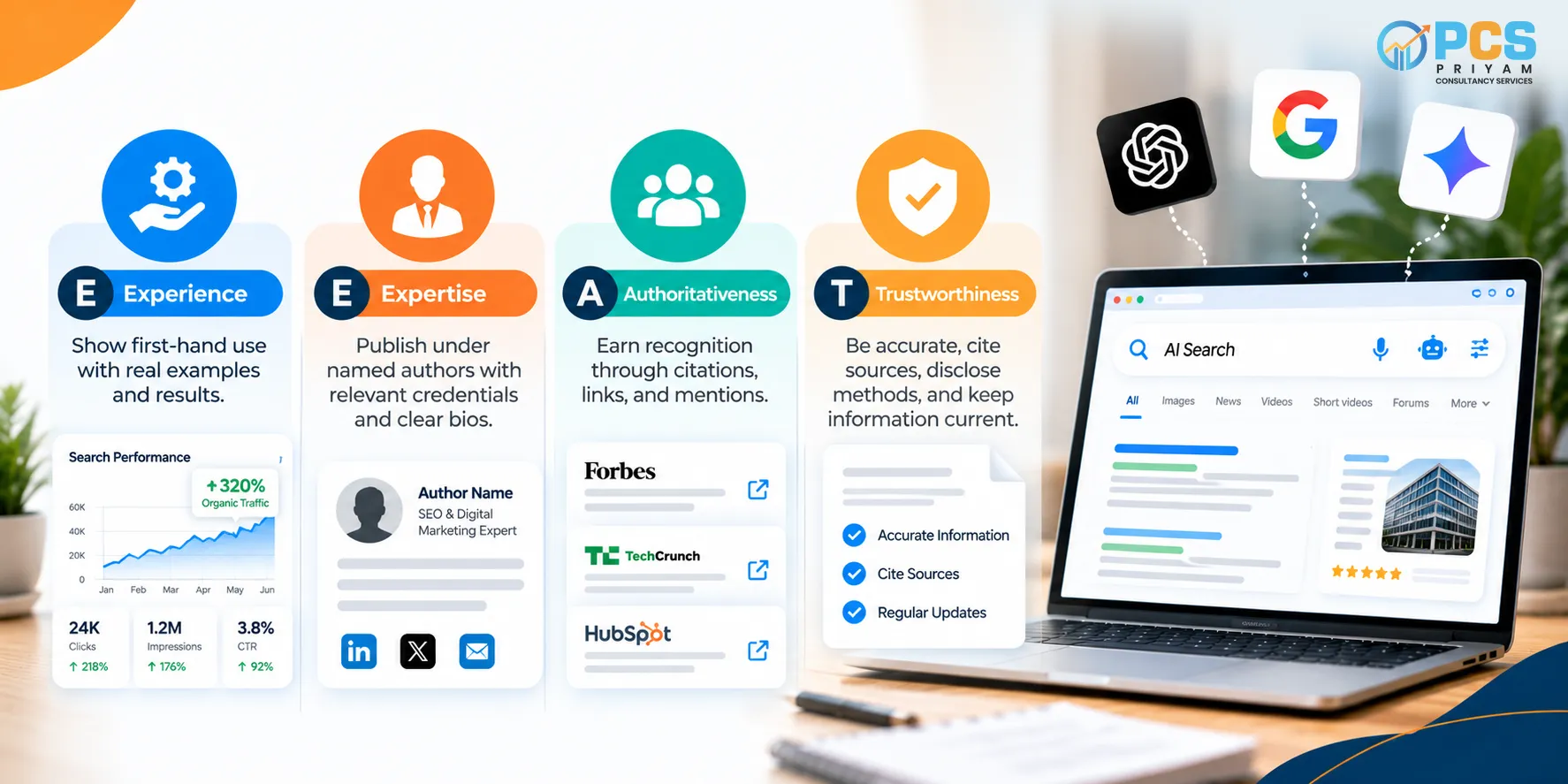
Content authority is the credibility of your content itself . It comes from showing your expertise, doing your research, giving factual information and covering a topic completely. Content authority is closely tied to the E‑E‑A‑T idea used by Google – Experience, Expertise, Authoritativeness, and Trustworthiness.
How AI Search Systems Retrieve, Evaluate, and Cite Sources
AI generated responses can be sourced from two main areas – information that the model picked up during training and information retrieved from the live web when a query is processed . Perplexity and Google AI Overviews focus largely on retrieving, while chat applications employ both approaches depending on the query and settings.
A simplified retrieval-based example looks like this:
- First, the system parses the question and generates sub-searches./li>
- Second, it retrieves potential pages from the search index.
- Third, it evaluates the pages for their relevancy, clarity and authority.
- Fourth, it generates a response citing its sources.
This is the reason why SEO for AI search engines is not a parallel universe to traditional SEO. Platforms differ. Google’s AI features draw on Google Search systems, so pages generally need to be indexed and eligible to appear with a snippet. ChatGPT search and Perplexity have their own retrieval and source-selection processes. Passing it, your page will be evaluated by its structure and credibility.
In traditional SEO, backlinks can influence rankings, although their impact varies by context . In AI search backlinks still matter. Their role is not as straightforward. They influence rankings in an indirect way but the effect is still present.
What backlinks can do in both environments:
- They help search engine crawlers find your web pages.
- They show that other websites view your content as trustworthy.
- They support rankings, which makes it more likely that your content will be found.
- A page can be cited in an AI-generated answer even if it has fewer backlinks than a competing page.
- The weight given to links may differ from traditional keyword competition, and it varies by platform and query.
- Clearly organized information may be easier for AI tools to use, although this is not a guaranteed citation factor.
Citations in AI answers can come from forums, news sites and niche sources—not high-authority websites.
The practical message: The practical message: keep building backlinks, but do not rely on them alone . A strong backlink profile gets you into the conversation. Authoritative content gets you quoted.
Linked vs. Unlinked Brand Mentions: What Do We Know?
Linked mentions pass traditional link signals. Unlinked mentions do not pass hyperlink-based link equity, but they may still contribute to brand recognition and topic associations.
Language models learn patterns from text. When your brand name repeatedly appears alongside a topic, in reviews, comparisons, discussions, and articles, that association may be strengthened . This is often called entity recognition: the system understands your brand as a distinct entity connected to certain subjects.
What we know with reasonable confidence:
- Mentions on trusted, relevant platforms may carry more value than mentions on obscure or unrelated sites, although the effect varies and is not consistently established for AI citations.
- Using the same brand name, description, and positioning across sources may make it easier for systems to recognize your brand, but this is a sensible practice rather than a confirmed AI mechanism.
- Community platforms, review sites, and news coverage are common places where brand discussions occur.
What remains uncertain is exactly how much weight each type of mention carries in a given AI product. Treat claims that give precise percentages with caution, and focus on earning real, relevant mentions rather than chasing a formula.
Content Authority, E-E-A-T, and Source Credibility in AI Search
AI search systems aim to surface sources that are relevant and useful, though how they select sources varies by platform. Content authority is how you show you’re one of them. The E-E-A-T framework gives a useful checklist:
- Experience: Show first-hand use. Include real examples, screenshots, test results, or lessons from actual projects.
- Expertise: Publish under named authors with relevant credentials and clear bios.
- Authoritativeness: Earn recognition from others through citations, links, and mentions.
- Trustworthiness:Be accurate, cite sources, disclose methods, and keep information current.
Content that tends to get quoted shares a few traits:
- A direct answer near the top of each section, which is a useful writing practice for readers and may make content easier to extract.
- Original data, research, or unique insight that can’t be found elsewhere
- Clean structure with descriptive headings, short paragraphs, lists, and tables
- Clear topical focus supported by related content, often called a content cluster
If your page says what everyone else says, an AI system has no reason to pick it. Original perspective can improve your chances of being cited, but it does not guarantee it.
Practical Strategies to Improve Visibility Across AI Search Platforms
- 1. Build quality backlinks. Focus on relevance and authority. Publish original research, create useful tools, contribute expert commentary, and pursue digital PR. A handful of links from respected industry sources beats hundreds of low-quality ones.
- 2. Earn brand mentions on trusted platforms.Participate genuinely in communities where your audience asks questions. Encourage customer reviews, pitch journalists, appear on podcasts, and share expertise publicly.
- 3. Write answer-first content. Put a clear 40-60 word answer directly under each heading, then expand with detail. This format is easy for both readers and AI systems to extract.
- 4. Strengthen entity signals. Keep your brand name, description, and author details consistent everywhere. Add structured data such as Organization, Article, Author, and FAQ schema where appropriate.
- 5. Cover topics in depth. Build clusters of related content so your site becomes a recognized source on a subject rather than a one-off result.
- 6. Keep content fresh.Update statistics, examples, and recommendations regularly, and show the last-updated date.
- 7. Make your site technically accessible. Ensure pages load quickly, are crawlable, and aren’t blocking the bots of AI search tools you want to appear in. Check your robots.txt settings deliberately.
This is the core of AI search optimization: strong traditional SEO fundamentals, plus content designed to be extracted and cited.
Measuring AI Search Visibility: Citations, Mentions, Traffic, and Conversions
Rankings by themselves no longer show the picture. To keep track of how visible your site is in AI search you need to watch four different levels.
- Citations: How often your web pages are used as sources in answers from AI tools.
- Brand mentions: How often your brand name appears in answers even if there is no link.
- Traffic: Visits that come from AI platforms, which you can see in your website analytics under sources like chatgpt.com or perplexity.ai.
Conversions: Whether the people who come from AI search actually sign up buy something or make a booking. Traffic quality is worth evaluating alongside volume, because a smaller number of well-matched visitors can be more valuable than a larger number of casual ones.
A good way to start is to create a list of 20 to 30 questions that your customers ask. Run these questions regularly through ChatGPT, Perplexity, Gemini and Google AI Overviews. Keep track of whether your site’s cited or mentioned. Special tools can help with this. A simple notebook or spreadsheet is enough to get started. Because responses can vary between runs, focus on trends over time rather than the results of a single test.
Common AI SEO Myths and Mistakes to Avoid
Myth: Backlinks are no longer important. They are still important for finding your website, getting a position in search results and building trust. The change is that backlinks are only one part of a broader visibility strategy.
Myth: AI SEO replaces SEO. Actually AI SEO is based on the principles of SEO.
Myth: Just having mentions is enough. Mentions can be helpful. Without good content and easy access they will not make a difference.
Mistake: Trying to get many links. Getting a lot of links through paid methods or low-quality ways hurts your trustworthiness.
Mistake: Creating repetitive content. Rewriting existing information without adding original value does not give a reason for AI systems to use or cite them.
Mistake: Ignoring structure… without clear answers are hard to understand and use.
Mistake: Thinking AI visibility is everything. No one can promise you citations. Focus on building trust. Expect realistic results.
Conclusion: Building Sustainable Authority for AI Search
Backlinks in AI search are best understood as one part of a larger authority system. Links can help search engines discover your pages and provide ranking signals . Brand mentions may help AI systems associate your brand with relevant topics . Content authority makes your pages worth quoting.
The brands that succeed in AI search won’t be the ones chasing tricks. They’ll be the ones that consistently publish original, expert-led content, earn recognition across the web, and make their information easy to find and use.
Your next step: Audit where you stand today. Check your top 10 pages for answer-first structure, review your backlink and mention profile, and test 20 customer questions across AI platforms. Then pick one gap and fix it this week. Authority compounds, so the sooner you start, the stronger your position becomes.
Priyam Consultancy Services (PCS) can help you build a practical plan for AI search optimization, from strengthening your authority signals to improving your AI search visibility. Get in touch with PCS to find out where your brand stands and what to fix first.
Frequently Asked Questions