Artificial intelligence is now part of everyday recruitment. Employers use it to screen applications, schedule interviews and answer candidate queries, while candidates use it to prepare and polish their applications. For HR leaders, the question is no longer whether to adopt AI in recruiting, but how to do so responsibly.
This difference is important. Just having technology doesn’t make hiring. If there are no rules, good data or people watching over the process, AI can make bad hiring habits happen faster. It can also bring in bias. Put companies at risk, for privacy and legal problems. Many HR teams are learning that buying AI tools is easy. Using them well is much harder.
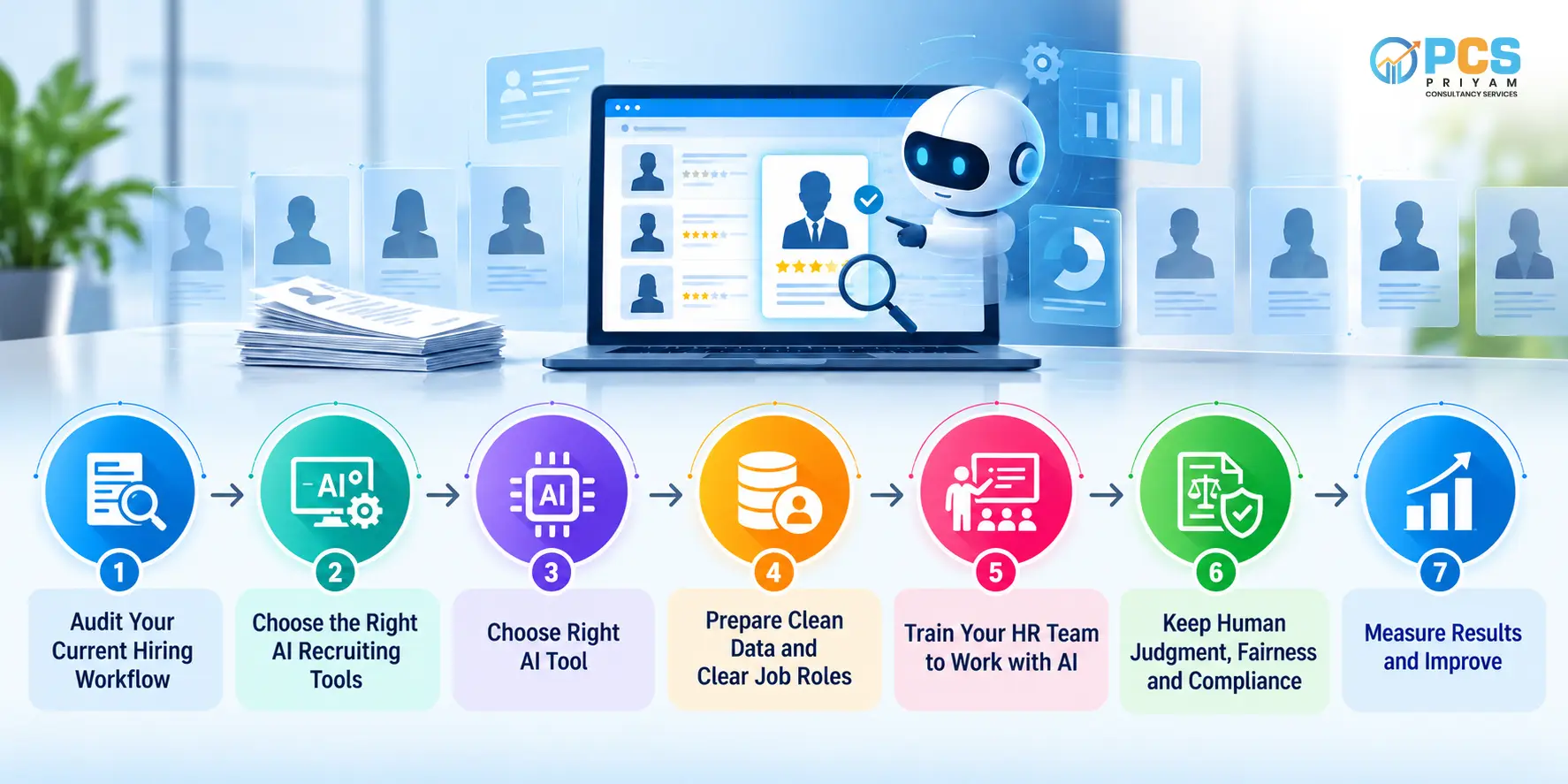
A smart AI hiring process faces these problems head-on. It mixes the technology with clear hiring goals, trained recruiters and results that can be measured. This blog shows seven steps to help HR teams and business owners make hiring much more efficient, fair and accurate.
Key Takeaways
-
-
- AI in recruiting works best on a clear, measured hiring process.
- Audit your workflow and record origin before adding tools.
- Begin with lower-risk administrative tasks and keep people accountable for decisions.
- Test tools for bias, check DPDP obligations and train recruiters.
Why AI in Recruiting Is Changing the Hiring Landscape
Owners use AI for screening, chatbots and scheduling promising speed and consistency. Applicants use AI to enhance applications so writing quality alone says less about ability.
Gartner reported in October 2025 that most HR leaders say their organisations have not yet realised significant business value from AI tools. The process around AI tools matters much as the software. Buying an AI tool does not make a company AI-ready.
How Does an AI-Ready Recruitment Process Look Like?
Assume AI scheduling interviews while recruiters talk to candidates.
Generally it depends on five things: hiring rules, trustworthy data, clear responsibility, good technology and trained recruiters. An AI‑powered recruitment process keeps people in control.
AI sorts, drafts and schedules while people make choices, on shortlists, offers and tough cases. Rejecting candidates automatically without review risks fairness and legal trouble.
Step 1: Audit Your Current Recruiting Process
Audit your recruiting process from applications to onboarding. Look out for delays and repetitive processes. Then identify the baseline metrics – time to fill, cost per hire, interviews to offer, and feedback from candidates. Record how these metrics are calculated.
Identify low-risk administrative recruiting processes which are measurable in their benefits. Such processes include scheduling, answering questions from candidates, updates, and drafting. Candidate ranking, screening, and scoring assessments are risky and even though human verification may help in reducing bias but it doesn’t completely eliminate it. Piloting on one family of jobs will enable you to adopt artificial intelligence into your recruiting process gradually.
Step 3: Choose the Right AI Recruiting Tools
AI recruiting tools are a mix of AI‑enabled tracking systems, screening platforms, chatbots and assessment tools.
When you talk to AI recruiting companies remember to ask a key questions:
- . Does the AI recruiting tool integrate with your ATS and HRMS?
- Can the AI recruiting tool explain why a candidate was ranked or rejected?
- Can the vendor prove that the AI recruiting tool is valid for the job and fair across all candidate groups? Where is the data?
- Can you export and delete it when the contract ends?
Separate the accuracy of the AI recruiting tool from performance that has been validated independently. Remember that employers usually remain responsible for outcomes even when a vendor’s tool is the cause.
Step 4: Prepare Clean Data and Clear Job Roles
AI is only as good as the data and roles you give it. You need to standardize job descriptions. Define what skills and traits matter for each role. Create clear scoring guides. Clean up candidate records so they’re accurate and fair. Before you even start tuning the AI system audit past hiring data. Why? Because old biases can sneak into the system and cause unfair results. A 2024 study, from the University of Washington looked at three resume-ranking models. It found that some models showed preferences based on names. That doesn’t mean every tool is biased. It’s a sign that bias can happen. So treat the study as a warning, not a verdict. Be careful. Check your data. Watch for hidden patterns. Make sure the AI helps you hire fairly.
Step 5: Train Your HR Team to Work with AI
Results depend partly on how well recruiters interpret outputs, spot limitations and apply professional judgment. Train them in AI basics and ethics, data literacy and change leadership. Include hiring managers too. Ask recruiters to log each override of an AI recommendation.
Step 6: Establish Fairness, Privacy and Human Oversight
Compare the selection rates between groups at every stage where AI is used. See these differences as signals to look into not as proof that there is treatment or bias. Write down the rules you use. Let candidates know when AI is involved.
Resumes and interview records are information. India’s Digital Personal Data Protection Act, 2023 and DPDP Rules 2025 create a step-by-step system that includes being clear, getting permission when needed, keeping data safe and giving people control over their information. The start of these rules is happening in steps and some important parts will be in place, around May 2027. Check when each rule applies to your situation. Look at how each tool deals with data and how long it keeps it. How it removes it. Do not put details of job applicants into public AI tools. Get help from a lawyer to understand what you must do.
Step 7: Measure Recruitment Performance and Improve
Define success before the pilot. Compare against baselines for similar roles and periods, and measure speed, cost, candidate experience, quality of hire and fairness. Continue, adjust or stop the pilot against criteria set in advance.
Common Mistakes When Adopting AI in Recruiting
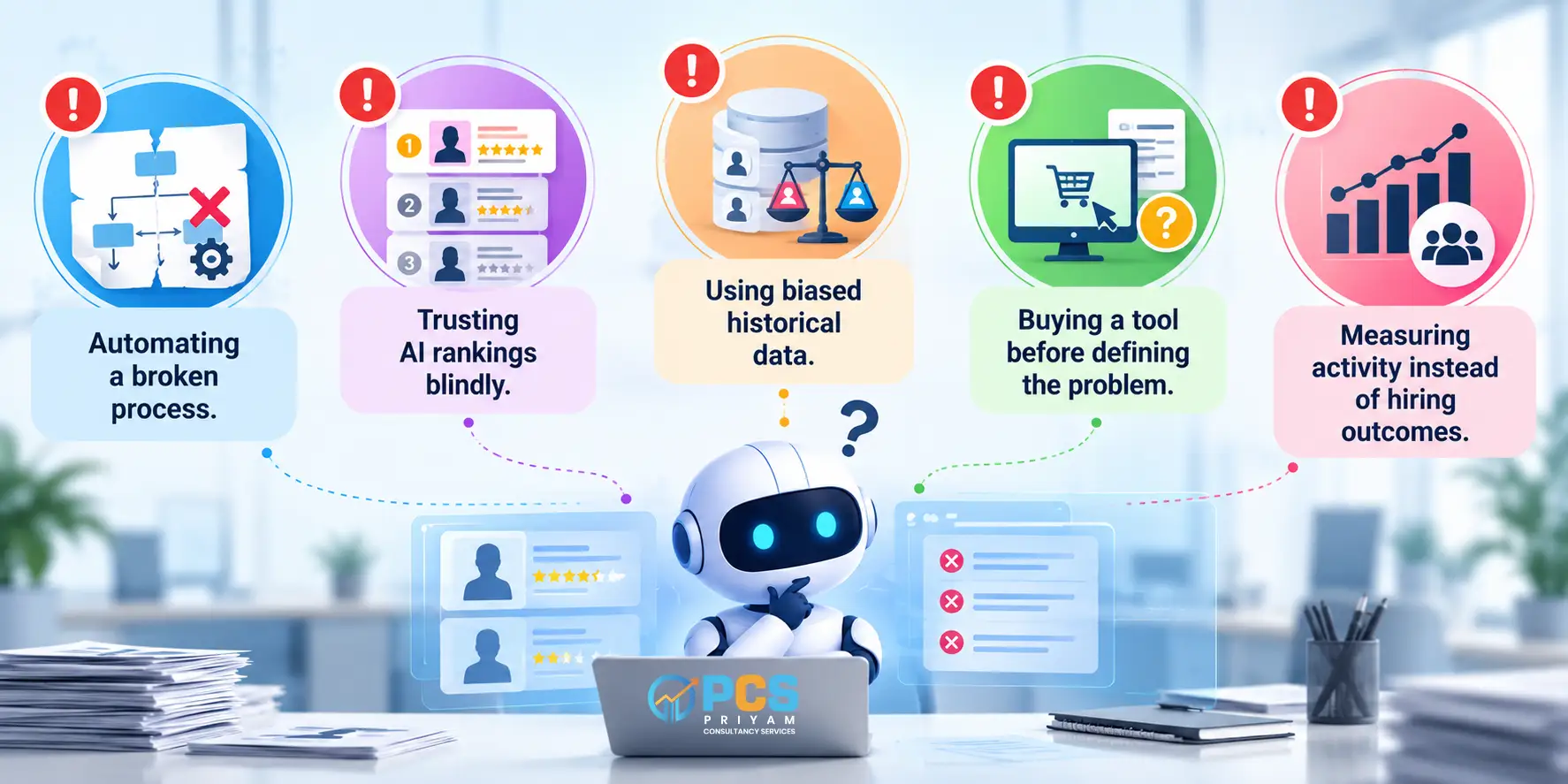
- Automating a broken process. AI makes existing delays and poor steps faster, not better.
- Trusting AI rankings blindly.Scores support recruiters and should never be the final decision.
- Using biased historical dataPast hiring patterns get copied and scaled by the system.
- Buying a tool before defining the problem. Without a clear problem and metric, success cannot be judged.
- Measuring activity instead of hiring outcomes.Screening more resumes means little if quality of hire stays flat..
The Future of AI in Recruiting: What HR Teams Should Prepare For
Recruitment technology will continue to grow and improve. More automation will be used in the hiring process. AI assistants will take care of tasks. There will be attention given to hiring people based on their skills. Recruiters will work closely with AI. People who are looking for jobs and those who check on the rules will want openness. HR teams that create flexible starting points now, with clear data, written standards and people who know what they are doing will be able to change more quickly as the technology changes.
How to Choose the Right HR Partner for AI-Enabled Hiring
AI recruiting companies sell software, while HR service providers run parts of the hiring process for you. Coimbatore employers often face high-volume and technical hiring, where consistent screening and clear processes matter most. For many, working with an HR consultancy in Coimbatore is a practical way to add recruitment expertise without building a full in-house team.
When comparing hr services and companies in Coimbatore, do not assume every provider has real AI expertise. Ask where AI is used, how bias is tested, how data is handled and what is reported.
Conclusion
The use of AI in recruitment is highly efficient if it is used within the context of a properly planned recruitment process which requires certain criteria, valid data, knowledgeable recruitment staff and a commitment to measurement. Begin with one problem and grow the process only when justified.
For companies which do not have their own HR transformation team, the correct partner company can devise the proper follow-up action plan. We at Priyam Consultancy Services offer you HR and recruitment solutions. Please contact us to find out how to get ready for AI in recruitment.
Frequently Asked Questions