Priyam Consultancy – Header
✉ info@priyamconsultancy.com 📞 +91 96774 44048

How AI Is Transforming Performance Marketing: A Practical Guide for Business Owners and Marketing Teams

Your ads can generate clicks every day and still miss your revenue targets. Today, AI powers performance marketing across bidding, targeting, creative, and reporting, while new AI assistants and ChatGPT ads are changing how campaigns are built. This guide explains what AI does, where it helps, where it fails, and how business owners and marketing teams can start with confidence.

Key Takeaways

      • AI drives performance marketing via bidding, targeting, creative optimization, and reporting.
      • This depends entirely on your goal and conversion tracking, so solve this problem first.
      • Use Google Ads and Meta Ads as foundational channels, and start testing ChatGPT ads now that they are live and open to Indian advertisers, with budget and proper conversion tracking.
      • AI will handle execution, while you own the goal, budget, brand, and compliance.

What Is AI in Performance Marketing?

AI in performance marketing uses machine learning to optimize paid campaigns toward measurable outcomes such as leads, sales, and app installs. It is part of artificial intelligence in digital marketing, but it focuses on results you can count and pay for. In plain terms, you tell the platform what success looks like, and AI tests, learns, and adjusts faster than a person can.

How Is AI Transforming Performance Marketing?

AI powers performance marketing in four main areas:
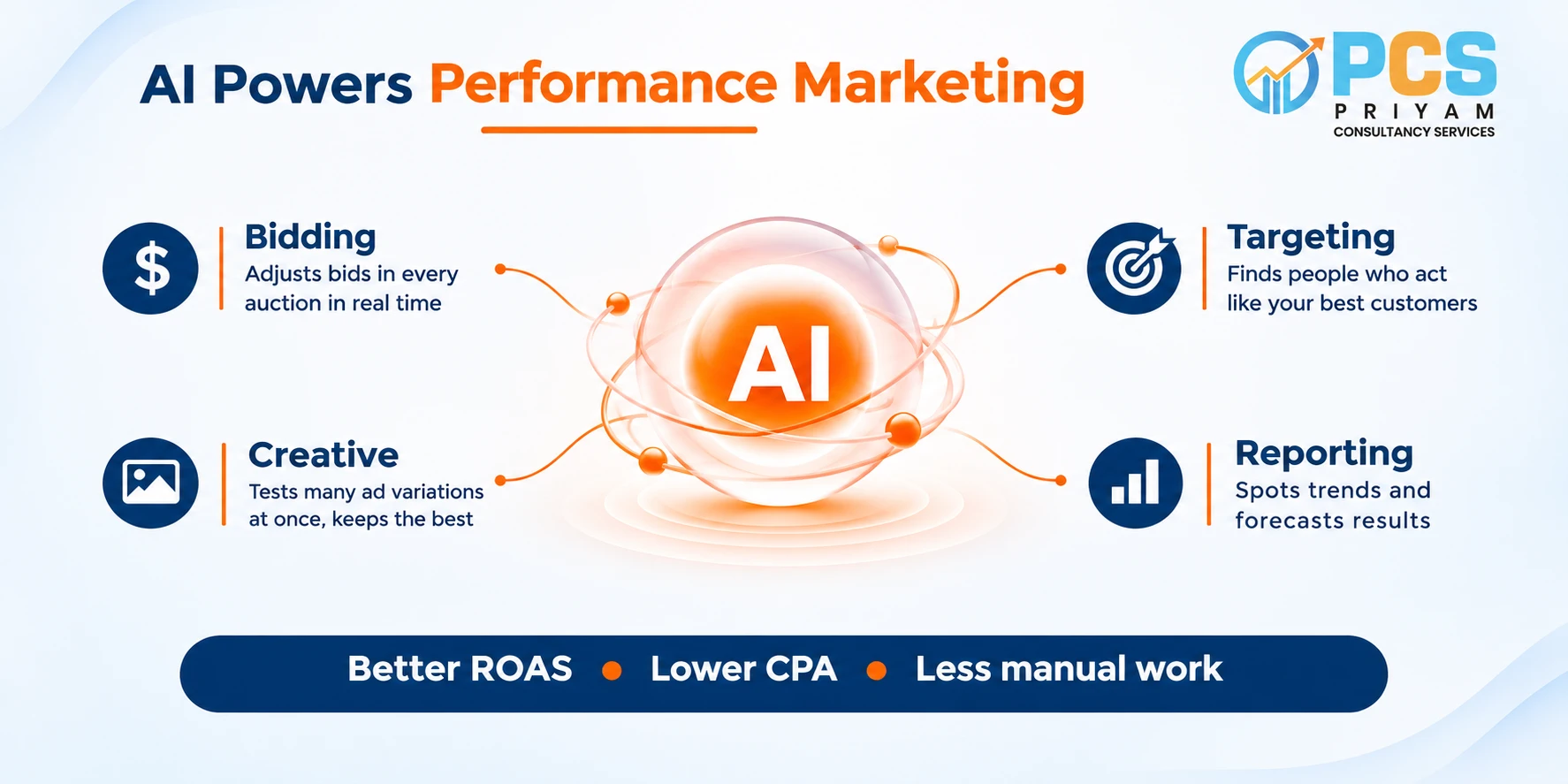
  • Bidding: optimizes every auction based on signals like device, location, and intent.
  • Targeting: looks at behavioral data, contextual data, conversion paths, and first-party data to find the people most likely to take action, while continually optimizing towards your objective.
  • Creative: automatically produces multiple headlines, images, and videos at the same time, but marketing teams have to make sure that everything meets the right quality standards.
  • Forecasting and reporting: identifies trends and forecasts outcomes.
Together, AI marketing automation cuts manual work and gives teams more time for strategy.

How Do Google Ads and Meta Ads Use AI?

Google AdSmart Bidding technology helps to optimize the pay-per-click advertisements with respect to your conversion objectives through various bidding strategies including Target CPA, Target ROAS, Maximize Conversions, and Maximize Conversion Value. The Automation feature of Advantage+ by Meta helps to optimize audiences, placement, and delivery for Facebook and Instagram, whereas its generative feature helps to build and optimize image and video advertisements. Meta has mentioned that more than 8 million advertisers have been using at least one of the generative features of Meta.
The assistant helps respond to queries and write content, while the agent performs multistep processes, for example, assessing performance or making changes to the marketing campaign. Google Ask Advisor operates through Google Ads, Google Analytics, and Google Merchant Center, while Muse from Meta is able to connect to ad accounts and business solutions from Meta. As per Meta, nothing will be published or spent without the permission of the owner of the account.

Are ChatGPT Ads a New Opportunity for Performance Marketing?

Yes, ChatGPT ads are sponsored content, tagged, and served separately from responses, while OpenAI’s Ads Manager enables advertisers to control their budgets and bids, along with tracking performance. For India, these ads have been served since August 27 for logged-in adult users who use the Free and Go plans, and the self-serve Ads Manager launched on September 4 with a minimum daily budget of ₹725. Brands in India can also use Razorpay Engage for catalog preparation, campaign creation, and tracking its performance. Not all queries show ads, and as it is a newly launched channel, start small.

How Do Google Ads, Meta Ads, and ChatGPT Ads Differ?

Feature Google Ads Meta Ads ChatGPT Ads
Type of Intent High intent: People searching for something Discovery: People browsing feeds Conversational intent: People asking questions or comparing options
Where Ads Appear Search, YouTube, Display, Shopping, Maps Facebook, Instagram, Messenger Inside ChatGPT, labeled as sponsored and shown separately from answers
Targeting Keywords, audiences, location, customer lists Interests, behavior, lookalike and custom audiences Topic and intent matched to the conversation
AI Features Smart Bidding, automated campaign types, Ask Advisor Advantage+ campaigns and audiences, generative creative, Muse Intent matching; retailer product feeds reported
Bidding Model Mostly cost per click, with conversion-based bidding Optimized for chosen goals (cost per result, CPM, or CPC) CPM and CPC bidding options; availability depends on the ad buying program
Best For Capturing demand: leads and sales from ready buyers Creating demand: awareness, e-commerce, retargeting Early testing of a new high-intent channel
Creative Style Text, shopping, and video ads Image, video, and carousel ads Sponsored text-style placements
Measurement Mature, with detailed conversion tracking Mature, with Pixel and Conversions API Developing, with impressions, clicks, and conversions
Availability Global, including India Global, including India Reported mainly for US advertisers
Maturity Established Established New and unproven

Why Do Most Paid Media Campaigns Still Underperform Even With AI?

As AI optimizes for the information you provide. Some common reasons can be attributed to faulty or duplicate conversion tracking, wrong goals set up (for clicks instead of money), lack of quality data, poor landing page performance and policy problems. Even the best PPC advertising companies can’t help if you have tracking problems. In one of our company’s client engagements, there was a certain policy issue in one of the Google Ads accounts. We did the necessary advertiser verification and acquired the appropriate advertising certification to demonstrate why this is so important for campaign management.

Conversion tracking should include more than clicks and form submissions. You need to create primary and secondary conversion actions, avoid duplicate events, link CRM data and import offline conversions. When it comes to B2B, measure the number of qualified leads and opportunities instead of just enquiry volume, because AI needs precise conversion and revenue data to optimize.

AI vs. Human Decision-Making in Performance Marketing: Who Should Decide What?

AI Decides Humans Decide
Bid adjustments in each auction Business goals and target CPA or ROAS
Audience matching Who your ideal customer is
Creative variations Brand voice, claims, and compliance
Budget shifts within limits Total budget and when to pause
Reporting and anomaly detection Strategy, interpretation, and next steps

How Can a Business Start Using AI in Performance Marketing?

  1. Fix conversion tracking first: Google tag, GA4, Meta Pixel and Conversions API, and CRM data.
  2. Define one clear goal, such as qualified leads or sales.
  3. Launch one campaign with one AI feature.
  4. Set budget caps and review ROAS and CPA weekly.
  5. Scale what works.

How Should Businesses Measure AI-Driven Performance Marketing?

Judge AI-powered campaigns by business outcomes, not clicks and impressions alone.
  • CTR (click-through rate): how often an ad earns a click.
  • CPC (cost per click): the average cost of each click.
  • CPL (cost per lead): the average cost of an enquiry or lead.
  • CPA (cost per acquisition): the cost of a customer or defined conversion.
  • ROAS (return on ad spend): revenue earned for every unit spent.
  • Conversion rate: the share of visitors who complete the desired action.
  • Qualified lead rate: the share of leads that meet your criteria.
  • Customer acquisition cost: the full cost of winning a new customer.
Combine platform data with CRM and sales data to confirm that AI optimization creates real business value, not just campaign activity.

What Is the Future of AI in Performance Marketing?

We can expect more AI-driven agents to handle campaign-related tasks in ads, analytics, and commerce, more ad forms within AI-powered chat and search services, and increasing demands for measurement. Human control will be required, because the same platforms that are selling the ads are also developing the AI managing the ads.

Conclusion

AI powers performance marketing best when it is paired with clean data and human judgment. Fix your tracking, set clear goals, test one AI feature at a time, and review results weekly. At PCS, we provide all performance marketing services, from account setup and conversion tracking to optimization and reporting. Contact PCS today for an audit and find out what to fix first.

Frequently Asked Questions

It is the application of machine learning in automation of paid campaigns toward measurable objectives such as leads and sales.
Judge them by clicks or conversions that can be tracked. ChatGPT ads are running in India and the Ads Manager is self-serve.
No. AI manages execution, while the people define goals, manage the budget, keep the brand safe, and interpret the results.
The assistant will provide answers and write the copy. The agent will execute the actions like creating and managing campaigns with your permission.

The AI learns how to perform based on the conversions you track, thus false conversions make it chase the wrong metrics.

Table of Contents

Related Posts

  • All Posts
  • Blog
    •   Back
    • Digital Marketing
    • Hr Services