For years, building a website meant weeks of back-and-forth between a client and a developer — wireframes, revisions, code, more revisions. That timeline is quietly collapsing. Tools that can turn a single sentence into a working, live website in under a minute are no longer a demo trick — they’re a genuine part of how AI website development happens.
That shift raises a real question for anyone running a business: if AI can generate a website this fast, do you still need a developer? The honest answer is more nuanced than “yes” or “no” — and it depends entirely on what you’re actually trying to build. This guide breaks down exactly what’s changed, what AI can genuinely do well, where it still falls short, and what that means if you’re deciding how to build your next website.
Key Takeaways
AI has made website development faster, simplifying layout, coding, and basic functionality. Tools range from no-code platforms like Framer and Wix to AI code generators like Lovable, v0, and Bolt.new, but choosing the right one is important. While AI speeds up execution, human expertise is still essential for strategy, design, architecture, accessibility, performance, and security. The best approach is to use AI for speed while relying on professionals for the judgment needed to build an effective, secure, and business-focused website.
What Is AI Website Development?
AI website development refers to using artificial intelligence — specifically large language models and AI coding agents — to generate, design, or assist in building a website, instead of relying entirely on manual design and hand-written code. This can range from a simple prompt-to-template tool that arranges pre-built sections based on your business description, to a full AI tool for website design that writes actual code you can export, modify, and deploy — though production readiness still depends on testing and review.
It’s worth noting this isn’t one single category of tool. In practice, AI in website development today splits into two very different approaches: AI-augmented no-code editors (tools like Framer or Wix, which layer AI features on top of a visual, drag-and-drop builder) and AI-native code generators (tools like Lovable, v0, and Bolt.new, which write real code from a natural-language prompt — sometimes called “vibe coding”). Understanding which category a tool falls into matters, because choosing the wrong one for your project can mean rebuilding from scratch later.
The Shift From Traditional Website Development to AI-Assisted Development
Traditional website development followed a fairly rigid sequence: gather requirements, design wireframes, get sign-off, write code, test, launch. Each step depended on manual execution, and each revision meant returning to a developer’s queue.
AI-powered website development collapses much of that sequence. Instead of a developer manually coding each section, an AI agent can generate a working layout, populate it with contextually relevant copy, and adjust it in real time based on feedback — all within the same conversation. The fundamental change isn’t that developers have disappeared; it’s that a large portion of the execution work has shifted from manual, line-by-line building to directing and refining what an AI system produces. This is the core of what people mean when they talk about website development using AI today — less typing, more steering.
How AI Is Changing the Website Design and Development Process
On the design side, AI has meaningfully sped up the parts of the process that used to take the longest: ideation and wireframing. Instead of starting from a blank canvas, a designer (or business owner) can describe a look and feel — “clean, minimal, professional services brand” — and get multiple layout variations back within seconds. AI-driven design tools can also generate color systems, typography pairings, and component variations far faster than manual exploration ever allowed, and some platforms now personalize layout choices based on early user behavior data rather than one fixed design for every visitor.
On the development side, this is where the shift is most dramatic. AI coding tools can now generate frontend components, wire up basic functionality, and even handle authentication or database setup through integrations — moving well beyond simple template generation into what’s now called “vibe coding,” where a plain-language description becomes a working application. The gap between what a template-based AI builder produces and what a custom developer produces has narrowed considerably, but it hasn’t closed completely — a distinction the next few sections dig into.
AI-Powered Development: From Prompt to Production
The most visible change in AI powered website development is the workflow itself: prompt in, working output out. A business owner can type a description of their site, and within minutes, get a live, functioning webpage — not just a static mockup, but something with working navigation, forms, and in more advanced tools, actual backend logic.
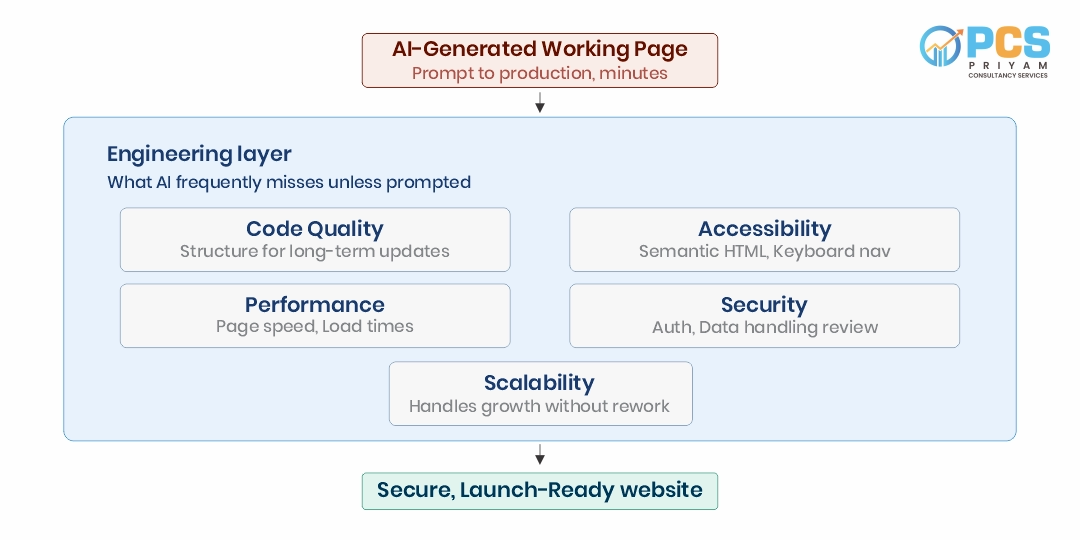
This works well for generating frontend code, building standard components (navigation bars, contact forms, product grids), and handling first-pass debugging — AI models are genuinely good at catching syntax errors and suggesting fixes. But “prompt to production” doesn’t mean “prompt to finish, launch-ready product.” Getting from a working first draft to something that’s secure, fast, properly structured for search, and genuinely aligned with a business’s brand and goals still requires a human developer reviewing, refining, and often rebuilding parts of what the AI generated. AI can accelerate a significant portion of the initial development work, but the remaining work — testing, refinement, and alignment with a business’s brand and goals — often requires substantial human review and engineering, not a full replacement for that judgment.
The Hidden Challenge: AI-Generated Websites Still Need Engineering
This is the part most AI website builder marketing conveniently skips: generating a working page is not the same as engineering a sound website. Several things AI-generated code frequently gets wrong, or simply doesn’t handle unless specifically prompted to:
- Code quality— AI-generated code often works, but isn’t always clean, maintainable, or organized the way an experienced developer would structure it for long-term updates.
- Accessibility —
Screen-reader compatibility, proper semantic HTML, and keyboard navigation are frequently missed unless explicitly requested.
- Performance —
Page speed and load times vary significantly between tools; some AI-generated sites ship bloated, unoptimized code that hurts both user experience and search rankings.
Security —
Authentication, data handling, and third-party integrations generated by AI need human review — a vulnerability introduced by an AI agent is still a vulnerability the business is responsible for addressing.
Scalability —
A site that works for a demo often isn’t structured to handle real traffic growth, added features, or a growing product catalog without significant rework.
None of this means AI-generated code is unusable — it means it’s a starting point that still needs engineering discipline applied to it, not a finished product ready to be handed to customers.
What AI Still Cannot Replace in Website Development
Even as AI tools get better at generating functional websites, there’s a category of work that remains fundamentally human:
- Strategic thinking — AI-Deciding what a website actually needs to achieve for a specific business, and which features matter versus which are noise, isn’t something a prompt can fully substitute for.
- Design judgment —
AI can generate dozens of layout variations, but knowing which one actually fits a brand’s positioning and audience still requires a trained eye.
- Business understanding —
AI doesn’t know your customers, your competitive landscape, or the specific objection your sales team keeps hearing — all of which should shape how a website is built.
- Technical architecture — Planning how a site will scale, integrate with existing systems, and stay maintainable over years, not months, is still a specialist skill.
- Human creative and design judgment —
This remains important, particularly when differentiation, brand positioning, and business context are what make a site memorable rather than an AI system optimizing for ‘what generally works.
This is really the honest dividing line between AI website development and professional development: AI is excellent at execution speed; humans are still necessary for judgment.
The Risks of Building Websites With AI
Alongside the genuine upside, there are real risks worth knowing about before building a business-critical website entirely with AI tools:
- Hallucinated information — AI can confidently generate incorrect facts, broken links, or inaccurate content if not carefully reviewed.
- Security vulnerabilities —
As noted above, AI-generated authentication or data-handling code can introduce weaknesses that aren’t obvious without a proper security review.
- Generic output — Because AI models are trained on common patterns, unedited AI-generated sites often look similar to each other, undermining brand differentiation.
- Copyright and data concerns — AI-generated images, copy, or code can occasionally raise licensing questions depending on the tool and its training data — worth checking before publishing.
- Overdependence on AI —
Businesses that rely entirely on AI output without a review process risk shipping a site nobody actually vetted for accuracy, tone, or functionality.
Treating AI as a first draft generator, with a human review layer before anything goes live, addresses most of these risks without giving up the speed advantage AI provides.
Conclusion : AI Won't Replace Website Development. It Will Redefine It
AI website development isn’t a passing trend — it’s a genuine shift in how the first stages of a website get built, and it’s not slowing down. But everything covered above points to the same conclusion: AI is redefining how websites get built, not eliminating the need for the expertise that makes them actually work — engineering discipline, design judgment, security review, and strategic thinking are still very human contributions.
At Priyam Consultancy Services (PCS), this is exactly how we approach modern website development — using AI where it genuinely accelerates the process, while applying the engineering, design, and strategic oversight that turns a fast first draft into a website that’s secure, fast, properly structured for search, and built to actually grow your business. Whether you’re exploring website development using AI for the first time or you already have an AI-generated site that needs a professional review before launch, we’re happy to walk you through what that could look like for your project.
Curious whether your website idea needs AI speed, human expertise, or both? Reach out for a free consultation and we’ll help you figure out the right approach.
Frequently Asked Questions