Every marketing team has had this argument at least once.
One side swears by SEO — the slow burn that builds something nobody can take away from you. The other side wants results by Friday — leads in the pipeline, clicks on the ad, numbers on the board.
Sound familiar?
Here is the thing nobody tells you when you are starting out. A business that bets everything on paid ads watches its leads vanish the moment the budget gets cut. A business that bets everything on
SEO spends months creating content while competitors run ads and grab the very customers they were waiting for.
Both strategies work. But alone? Each one has a ceiling — and most businesses hit it faster than they expect.
The brands quietly winning right now are not picking sides. They are using SEO to build trust and long-term visibility while using performance marketing to capture demand right now. One fills the pipeline today. The other makes sure the pipeline never runs dry tomorrow.
That is not a luxury strategy. That is just smart marketing.
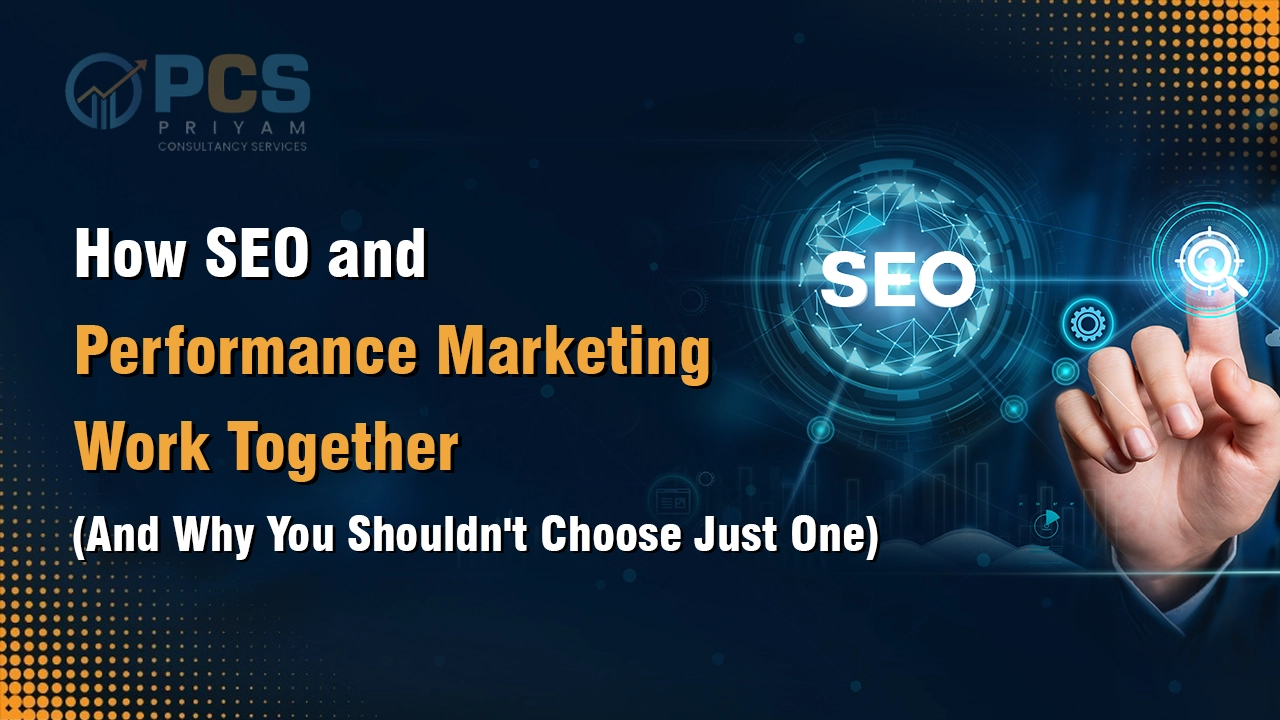
So the real question was never SEO vs performance marketing. It was always — how do you make both work together for your business? That is exactly what this blog breaks down.
What is SEO — And Why It Feels Slow But Hits Hard
Think of SEO like planting a tree.
You dig the ground, water it consistently, and for a long time — nothing visible happens. But underneath, roots are forming. The authority is building. And when that tree finally grows, it gives shade for years without you having to do anything extra.
That is what digital marketing through Search Engine Optimization does for a business.
SEO is the process of making your website more visible on search engines so that when someone searches for what you offer, your website shows up — without you paying for that click. It involves understanding what your audience is searching for through keyword research, creating content that answers those questions, fixing the technical health of your website, and earning credibility through backlinks to improve your search engine ranking.
The real power of Search Engine Optimization is what happens over time. Every blog you publish, every page you optimize, every link you earn, it all adds up. After six months you will see your traffic grow. After one year you will notice that the cost per lead goes down. After two years your website becomes something that really works for you all the time every day helping you build your brand online.
Let me be honest with you. Search Engine Optimization is not for businesses that need to see results away. It takes a lot of patience. You have to be consistent. You have to be willing to wait for a time to see the results. If you think you will get results overnight you will probably give up before you even see any progress, with your Search Engine Optimization.
What is Performance Marketing — And Why It Is Not a Silver Bullet
Now imagine you need customers this month. You have a product launch. A seasonal offer. A target to hit before the quarter ends.
That is where performance marketing earns its place.
Performance marketing is exactly what the name suggests — you pay for performance. Clicks, leads, conversions, sales. Through pay per click marketing, display ads, and social media campaigns, you can get in front of the right audience within hours of launching a campaign. You can test what works, cut what does not, and scale what drives results — all in real time.
The numbers do not lie. You can track your click through rate on every ad, measure your conversion rate down to the last rupee, monitor your return on ad spend and make decisions based on data rather than gut feeling. This makes it one of the sharpest tools in digital marketing today.
But here is what the sales pitch leaves out. The moment you stop spending, everything stops. No budget, no traffic. No traffic, no leads. For businesses that rely entirely on paid ads, this creates a dangerous dependency — one budget cut or one bad month can bring the entire pipeline to a halt.The numbers do not lie. You can track your click through rate on every ad, measure your conversion rate down to the last rupee, monitor your return on ad spend and make decisions based on data rather than gut feeling. This makes it one of the sharpest tools in digital marketing today.
Performance marketing is a powerful engine. But engines need fuel. And fuel costs money — every single day.
Organic Traffic vs Paid Traffic — What Nobody Tells You About Both
But the real picture is more nuanced than that.
Organic traffic — the kind that comes from SEO — builds slowly but carries something paid traffic rarely does: genuine intent and trust. When someone finds your website through a search result rather than an ad, they came looking for you. That changes how they engage, how long they stay, and how likely they are to convert over time. It also strengthens your brand visibility online in a way that no ad impression can replicate.
Paid traffic is immediate and precise. You can target by location, by interest, by behaviour, by the exact keyword someone just searched. For a business that knows its customer well, this level of targeting combined with strong pay per click marketing is incredibly powerful. Your conversion rate can improve faster, campaigns can be adjusted on the fly, and results are measurable from day one.
The cost dynamic is where it gets interesting. Organic traffic feels free — but it costs time, content, and expertise upfront. Paid traffic feels expensive — but it delivers returns immediately. Over time, a strong SEO foundation actually reduces how much you need to spend on paid ads, because your website starts generating leads on its own.
The smartest businesses do not choose between the two. They use paid traffic to generate results while SEO is building — and once SEO kicks in, they reinvest the savings back into sharper, more targeted paid campaigns.
SEO vs Performance Marketing — An Honest Comparison
Which is Better SEO or Paid Ads?
Here is the honest answer. It really depends on where your business is right now.
If you are a business that needs customers immediately to survive, performance marketing is where you should start. You can’t wait six months for SEO to start working when you have bills to pay and goals to meet. A good plan to get leads fast is to use pay per click marketing.Here is the honest answer. It really depends on where your business is right now.
If you are an established business with some time to plan and a long-term goal, SEO is very important. Every month you wait is a month your competitors are getting ahead of you in search engine rankings.
If you are a business that wants to grow in a sustainable way. The answer is not just one or the other. It is both working together, each making the other better.
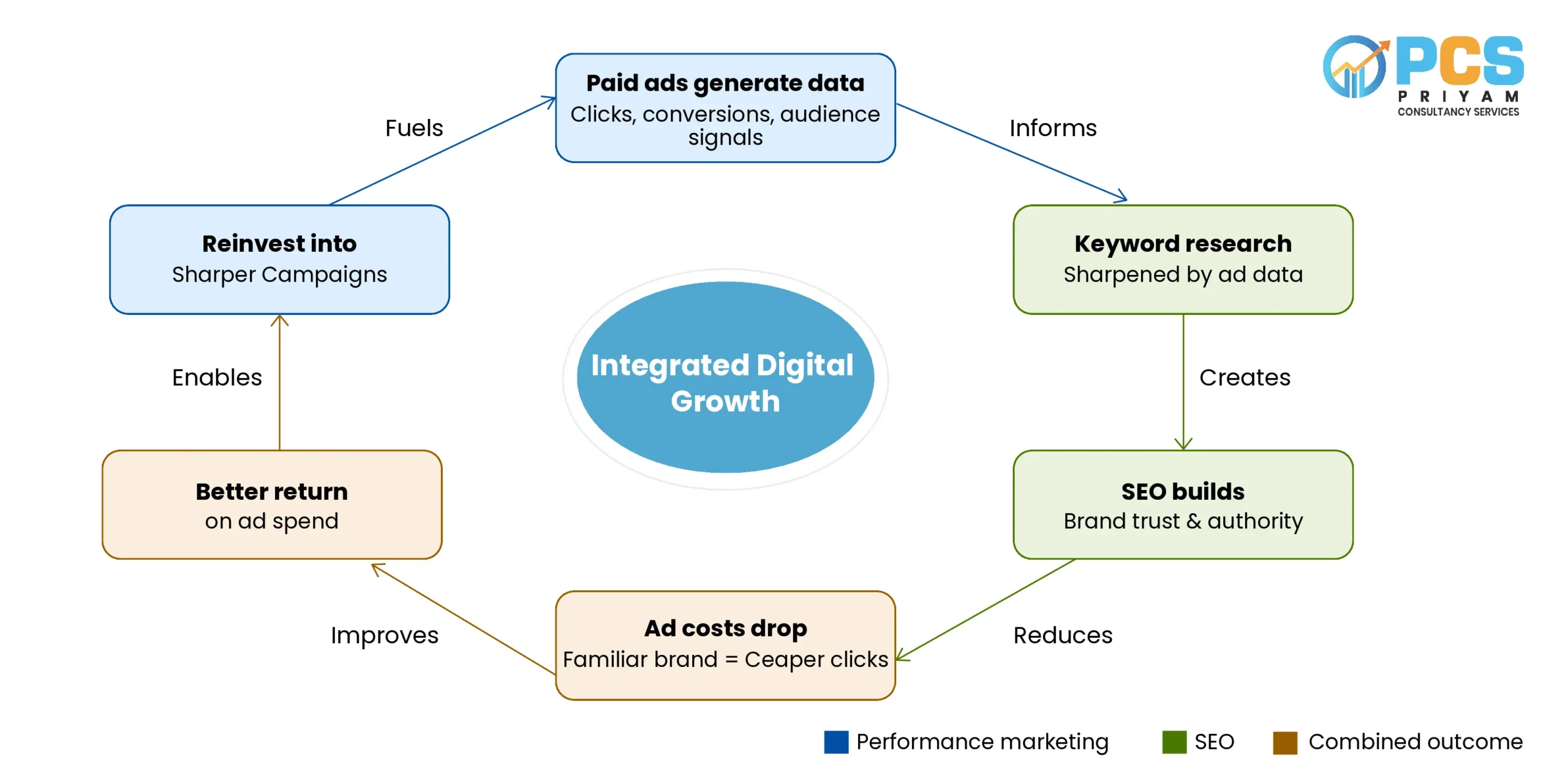
Paid ad campaigns give you information about what your audience likes. That same information helps you choose keywords and make a better content plan. Your SEO content helps people know your brand online which makes your paid ads cheaper to run because people already know your name. Your ad click through rate gets better because people already trust you. Your return on ad spend gets better because people who already know you are more likely to buy. The cycle keeps going.
Case Study — Healthcare SaaS Platform
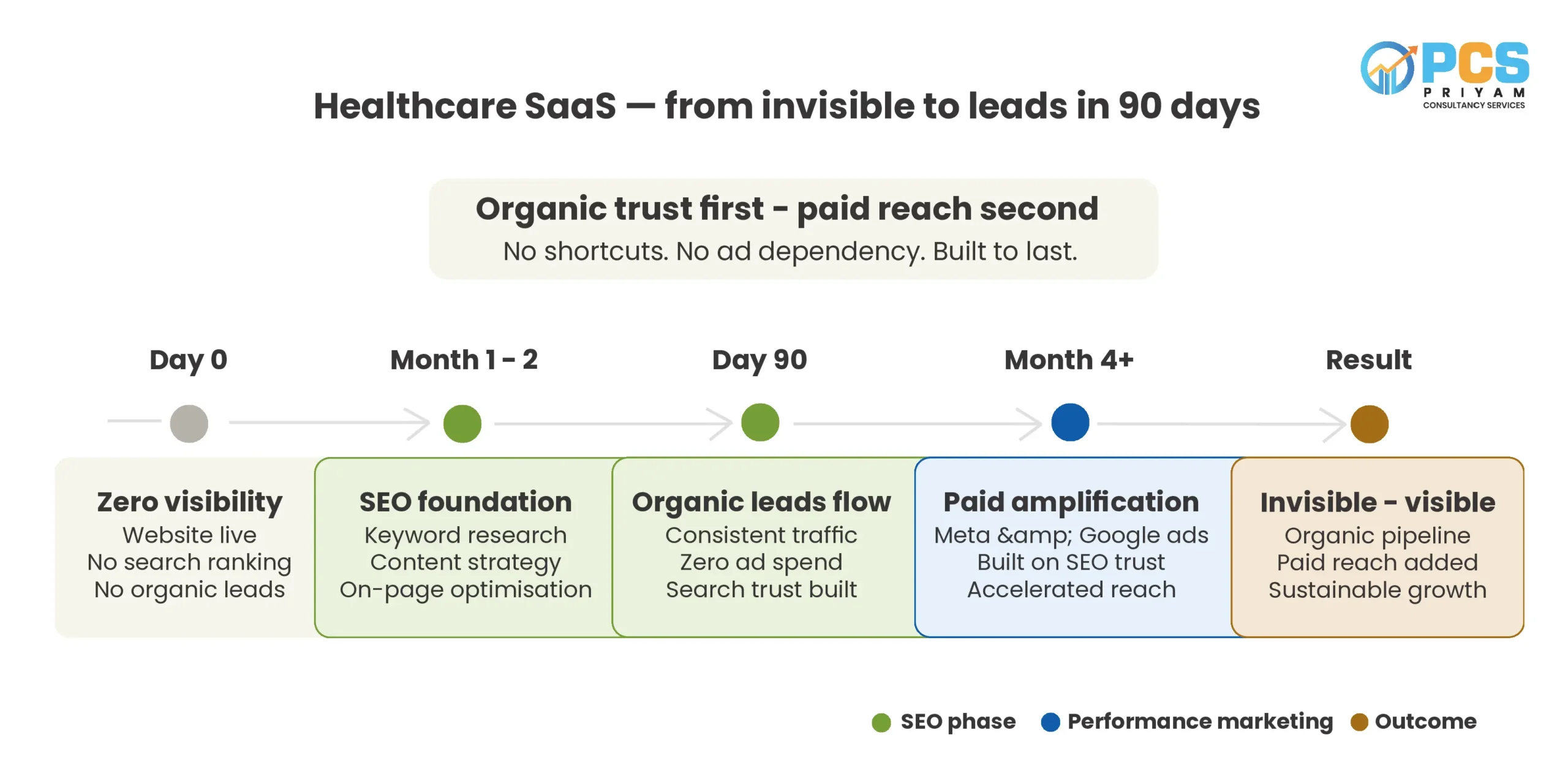
A healthcare SaaS platform had a website and social media handles, but zero online visibility. Nobody could find them. They were invisible where it mattered most — search engines.
We started from scratch with SEO. We built their online presence from the ground up — keyword research, content strategy, on-page optimisation. No paid ads. Just focused SEO work to make them discoverable.
90 days later, leads started coming in consistently — completely organically, without spending a single rupee on ads.
Once the organic foundation was solid and leads were flowing, we launched performance marketing campaigns on Meta and Google to accelerate what SEO had already built — reaching more of the right people, faster.
The result was a business that went from invisible to visible — built on organic trust first, powered by paid reach second.
Conclusion — Stop Choosing. Start Combining.
The debate around SEO vs performance marketing was never really a debate. It was always a false choice.
SEO builds the kind of authority and trust that no ad budget can buy overnight. Performance marketing delivers the speed and precision that no amount of content can match in the short term. Together, they create something neither can achieve alone — a digital marketing engine that generates results today and keeps growing tomorrow.
The businesses winning in search right now are not the ones who picked the right strategy. They are the ones who refused to pick just one.
If you are ready to build a strategy that works on both fronts, that is exactly what we do at
PCS — strategic SEO, performance-driven campaigns, and the kind of integrated thinking that turns marketing spend into long-term business growth.
Frequently Asked Questions