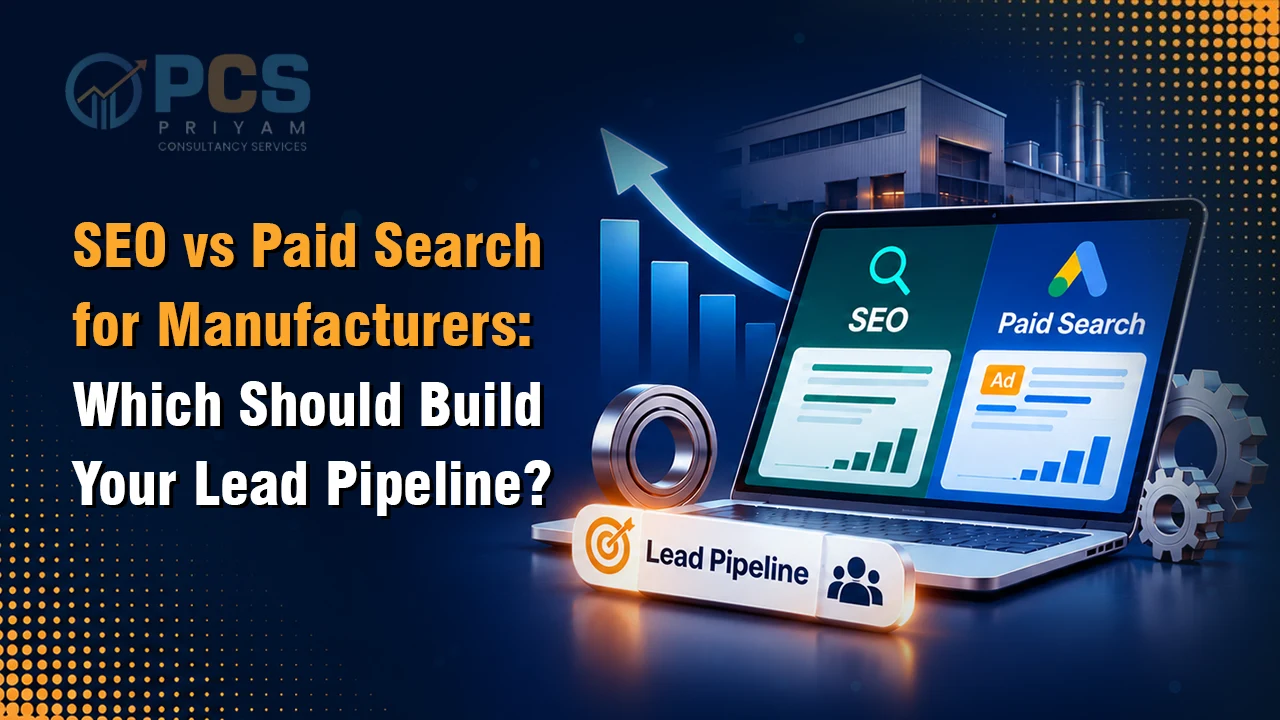
For many years, order books have been completed depending on the outcome of trade exhibitions, the cooperation with distributors and recommendations. All those are still important components, but they are not enough anymore. Nowadays, the purchasing agents and the engineers examine the companies on the Internet prior to any phone calls. And in case they do not find your company during the examination, they will definitely find your competitors.
Therefore, the challenge that is set up for the entrepreneurs nowadays is to understand how to spend the money allocated for marketing activities. This article does not intend to argue about which way – either SEO or PPC is better for the manufacturer. This is merely a description of both methods and a help in choosing the one.
The visits to the site are just one of the indicators of success of a business. In this case, the target is not just attracting visitors but attracting the right kind of industrial buyers who would provide the requests and RFQs.
Why Do Industrial Buyers Start Their Supplier Search on Google?
Procurement in industry has changed. Modern buyer conducts his own research first, studying capabilities, certification, material, lead times and only after that reaching out to any suppliers. Normally, Google becomes the first place where one can get all the information – whether “CNC Machining Supplier”, “Custom Fabrication Near Me” or even a specific specification of a part.
Buying process in manufacturing requires much longer decision-making cycles and involvement of multiple people. When an engineer tries to gather technical information, the manager of purchases wants to get prices and credible data, and the owner of the business wants to estimate the possibility of cooperation. All three conduct their researches, read and compare. The suppliers, who constantly come up with credible content, acquire credibility in silence.
The reason why visibility in search became essential is obvious. SEO and PPC make them visible to such buyers, however, each of them performs the task differently.
It means that search visibility is necessary, but visibility by itself is not sufficient. Website of a manufacturer must help potential buyers to learn about its capabilities and decide to reach out for further communication.
It is possible that there are various forms of searching for various stages of industrial buying. Informational search is the search for knowledge about processes or material, while commercial search involves comparison between the supplier’s capabilities. Transactional search is the urgency of need, such as quotation request. SEO and Paid Search may help in helping the manufacturers reach their customers.
How Does Paid Search Bring Quick Enquiries to Manufacturing Businesses?
PPC, Pay Per Click, means that your ads will appear in the search engine results for selected keywords and you will pay each time someone clicks on them. The fact that the ads will appear almost instantly after the approval of the campaign means that it may attract enquiries instantly too.
The main benefits for manufacturers include:
- Speed: you contact buyers almost instantly.
- Targeting: you may select keywords, geographic regions, device types and day time periods.
- Measurability: clicks, enquiries and budget spendings are measurable.
- Control: you have control over the budget and you may increase or decrease it whenever needed.
In industrial marketing campaigns, the landing page must correspond to the search of the customer. The customer who searches for precision machining should land on the capability page and be able to get a quote there.
SEO vs PPC for Manufacturers: Which Channel Delivers Better Returns?
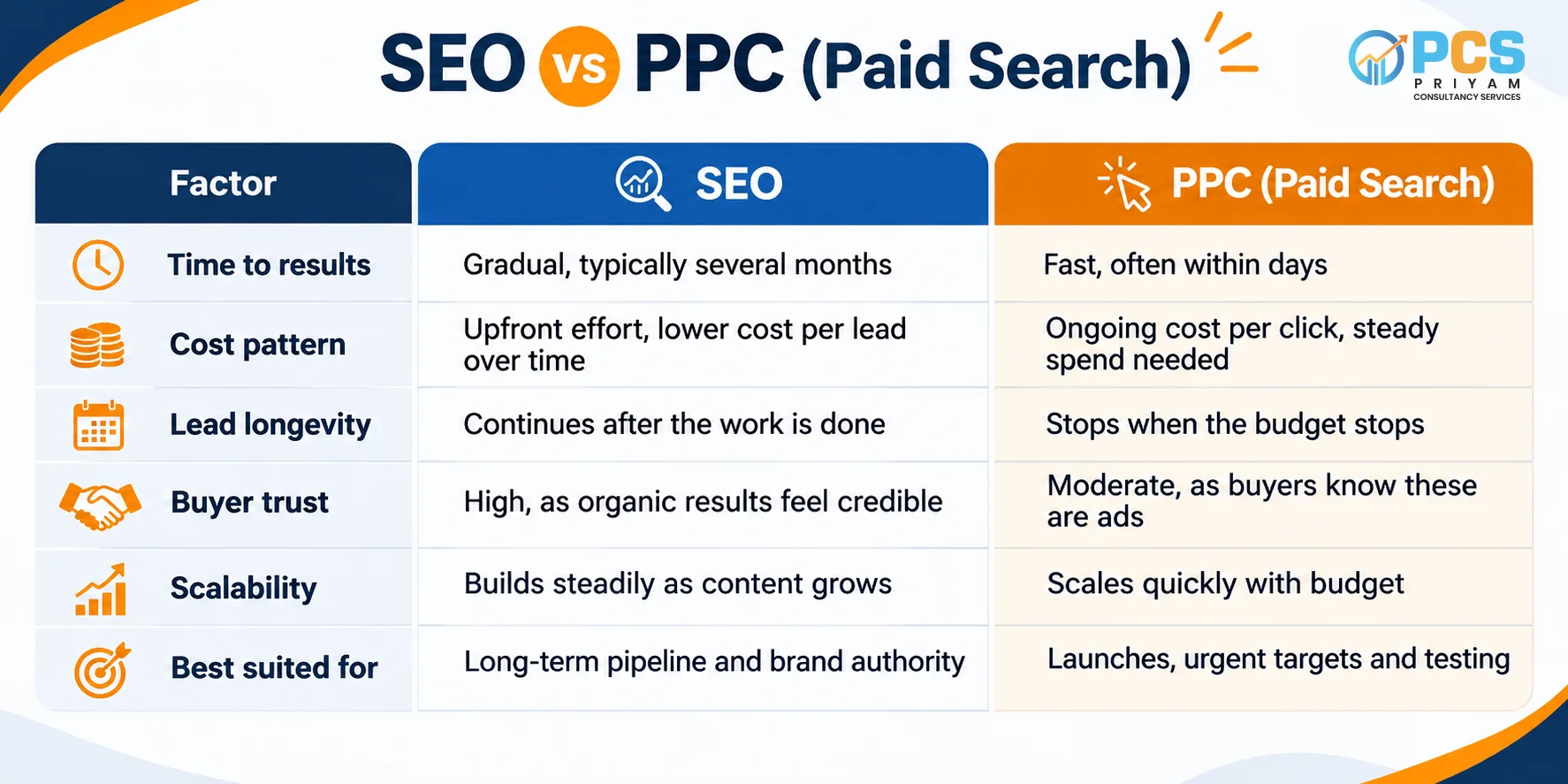
Both channels bring in leads, but they behave differently. The comparison below shows how they stack up on the points that matter most to business owners.
The right balance depends on how quickly you need leads and how long you plan to invest.
It also helps to remember that SEO is one discipline within the wider field of digital marketing. Understanding search engine optimization in digital marketing means seeing it as the foundation that supports your website, content, reputation and, ultimately, your paid campaigns too.
A fair comparison should also consider the quality and commercial value of the leads generated. A campaign that produces fewer but more relevant RFQs may be more valuable than one that produces many low-quality enquiries.
Three questions will help to determine the best fit for a channel mix.
- How fast do you need visibility and enquiries? Paid search can provide more immediate visibility. SEO takes longer, depending on the website and the competitiveness of the market.
- What products and markets need attention most? Take into account product margins, production capabilities, target sectors and markets, the competitiveness of the sector and the potential commercial value.
- Can you track what happens after an enquiry? If the lead generation cannot be measured, it is not clear how much either channel delivers in commercial terms.
Can Manufacturers Combine SEO and PPC to Build a Stronger Lead Pipeline?
Yes, indeed, and these methods go very well together. The PPC and SEO are the components of the digital marketing and search engine optimization campaigns with a common objective, namely to reach the appropriate audience on your site and get them to inquire.
What we know with reasonable confidence:
Keyword insight: PPC gives insight into the conversion rate for certain keywords and helps you select SEO keywords.
Expanded presence on search engines: getting listed in paid search results and organic search increases the presence of the same search.
Optimized landing pages: landing pages that have been proven successful in PPC can now be optimized for organic searches.
Coherence: a cohesive strategy helps improve recognition of your brand.
In case of manufacturers dealing with specialized or high-value products, another method can be used to complement these two methods. This is called Account-Based Marketing (ABM), which is not a substitute for SEO and PPC.
How Can Manufacturers Convert Website Traffic into Qualified RFQs?
Website traffic has commercial value when the correct customer makes the next move. In most cases, this will be a Request for Quotation (RFQ). The RFQ landing page should clearly define the next move and gather enough information to conduct an initial technical and business evaluation without generating friction.
- Product description or part description along with its application.
- Drawing, specification or reference documentation, if needed.
- Materials, size, tolerance or applicable standards.
- Approximate quantity or volume.
- Required delivery schedule and destination.
- Contact information and company information.
A manufacturer should create its own process for managing RFQs. It is important to identify an owner of each request, acknowledge the request, conduct technical review and define a next move. Track RFQs based on their origin and evaluate the number of qualified opportunities and quotations generated.
Aligning Marketing and Sales: From Industrial Enquiry to Order Conversion
Industrial selling processes may include technical explanation, sample creation, vendor registration, auditing, quotation, negotiation, and internal approvals. Thus, marketing success should be linked to the selling process. CRM systems will document where the inquiry came from, whether the inquiry has been qualified, who the sales person was assigned, what the quotation was worth, any follow-ups made, and the result obtained.
Marketing and Sales must determine what constitutes a qualified lead, how soon inquiries must be followed up, when an opportunity is taken by sales, and how the winning and losing of opportunities is tracked.
Which Numbers Show Whether Your Lead Pipeline Is Working?
For comparing SEO with PPC, manufacturers can measure the impact on both business and traffic metrics. The following metrics may help:
- Qualified leads: leads that satisfy your customer and requirements criteria.
- Cost per Qualified Lead: total cost of campaign and marketing related to it divided by the number of qualified leads.
- Conversion Rate:percentage of visitors that take some action related to the enquiry.
- Number of RFQs:number of actual quotations that come through.
- Lead to Opportunity and Opportunity to Win ratio:leads converted to opportunities and opportunities converted to orders.
- Organic Visibility:Increase in Organic Impressions, Clicks and Qualified Enquiries.
- Pipeline Value and Revenue Impact: Opportunities and revenue attributed to marketing.
ROI is not calculated by dividing revenues by cost. One standard equation is ROI = (Return from investment − Cost of investment) ÷ Cost of investment x 100. ROAS, on the other hand, differs from this because it is the comparison of attributed revenue with ad spend.
Check these metrics periodically, taking into account the long sales cycles involved in the industrial sector, as well as consistent definitions of leads, opportunities, and revenue for SEO and PPC.
Why Should Manufacturers Invest in an SEO Optimization Service?
SEO involves technical audits, keyword research, content creation, link building and constant monitoring. For a manufacturing business owner already managing production, suppliers and customers, it is hard to do this well in-house.
A professional SEO optimization service brings expertise and structure. It can audit your website, fix technical issues, optimize product and capability pages, create content that answers buyer questions, and track results against real business goals. It also helps you avoid the common mistakes listed above and saves months of trial and error.
Priyam Consultancy Services helps businesses stay visible on Google and in AI-driven answers. We review your website, fix your SEO basics and build content that search tools can trust, so your brand is found when customers ask questions.
Case Study: How We Built a Digital Foundation for Growth of VATCOMM Technologies
A patch cord manufacturer and networking solutions provider, VATCOMM Technologies Private Limited catered to infrastructure, telecom, and industrial sectors. Though VATCOMM had strong technical capabilities, it did not have any website. The company worked only through offline marketing channels, which restricted its visibility and credibility among online buyers who do their research and verification through the internet. PCS created its very first website for VATCOMM from scratch according to its brand identity, including AI-powered content, mobile-friendly design, presentation of its patch cords and networking products, SEO structure of the pages, and calls to actions.
In this way, VATCOMM got an excellent digital presence where it did not exist before and gained visibility and credibility online, thus, making it a strong base for further business development. When manufacturers enter into the new regional market, they get the same starting point – SEO and PPC both require credible and structured websites where buyers will be redirected to. Having a website done, then paid search helps to become visible in the new region quickly, while regional SEO content works on long-term visibility, and it is enquiries and RFQs, not visits, that should be considered.
Conclusion
It is not so much whether SEO or PPC is more beneficial in itself but rather which one should drive your pipeline of leads. In most cases, Search engine optimization is the more powerful platform because of the lesser cost per lead and higher authority and constant stream of inquiries. PPC is about quick action and control over it and thus best suited for launches and tests.
The best way forward is to combine both approaches: generate your natural traffic through consistent manufacturing SEO and pay for search when you need to act fast. Measure everything that counts and with proper approach and partner, search will be your most reliable source of qualified leads.
If you feel the time has come to increase your online visibility, contact Priyam Consultancy Services and we will develop an SEO and digital marketing strategy for your manufacturing company.
Frequently Asked Questions