
AI Search Optimization: How to Get Your Business Found in ChatGPT, Gemini and Google AI Search Search no longer ends...
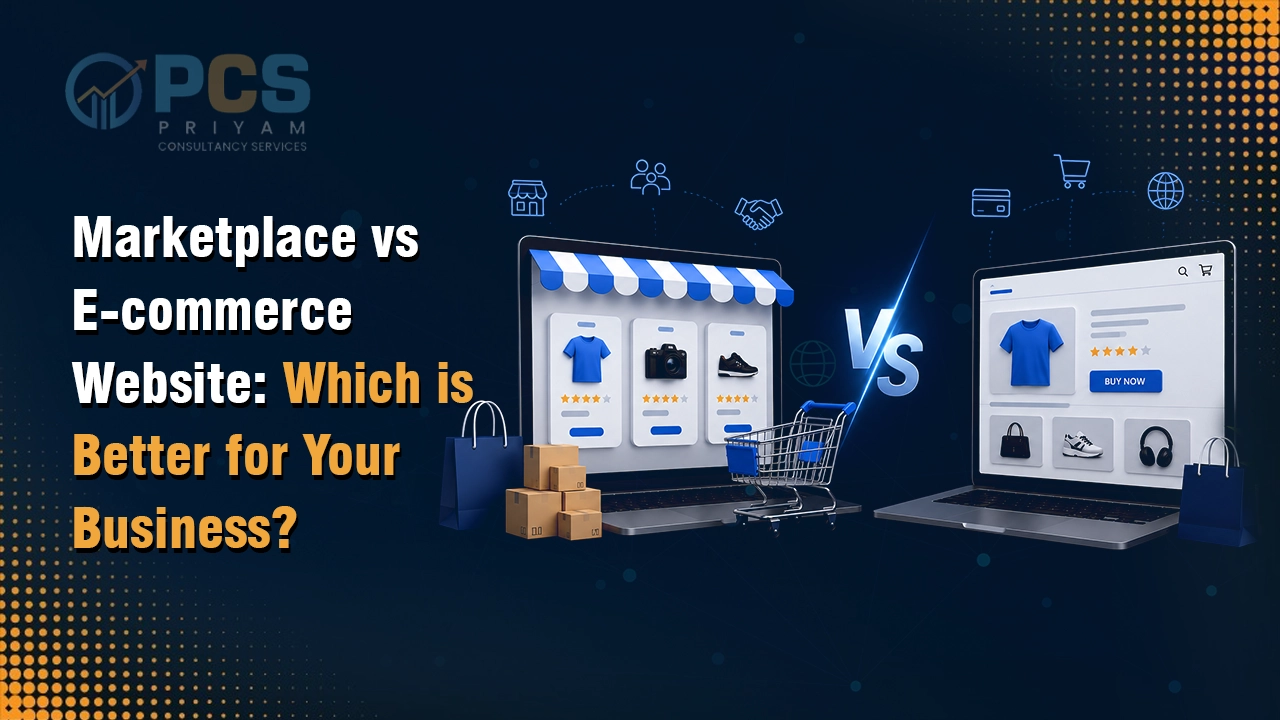
Thousands of Indian businesses are generating sales every day and still not growing. The reason is almost always the same — they are building revenue on platforms they do not own, for customers who will never remember their name.
India now has 270 million online shoppers, surpassing the United States to become the world’s second-largest e-retail market. The country’s e-commerce sector is projected to grow from $125 billion in 2024 to $345 billion by 2030. For businesses looking to grow online, the opportunity has never been bigger.
But entering the digital space comes with an important decision that every business faces sooner or later. Should you sell through Online Marketplaces where customers already exist? Or should you build your own ecommerce website and create a brand that truly belongs to you?
At first, marketplaces feel like the obvious choice. They are fast, familiar, and already filled with buyers searching for products every single day. You can upload products, start selling quickly, and see orders coming in without spending months building an online presence from scratch.
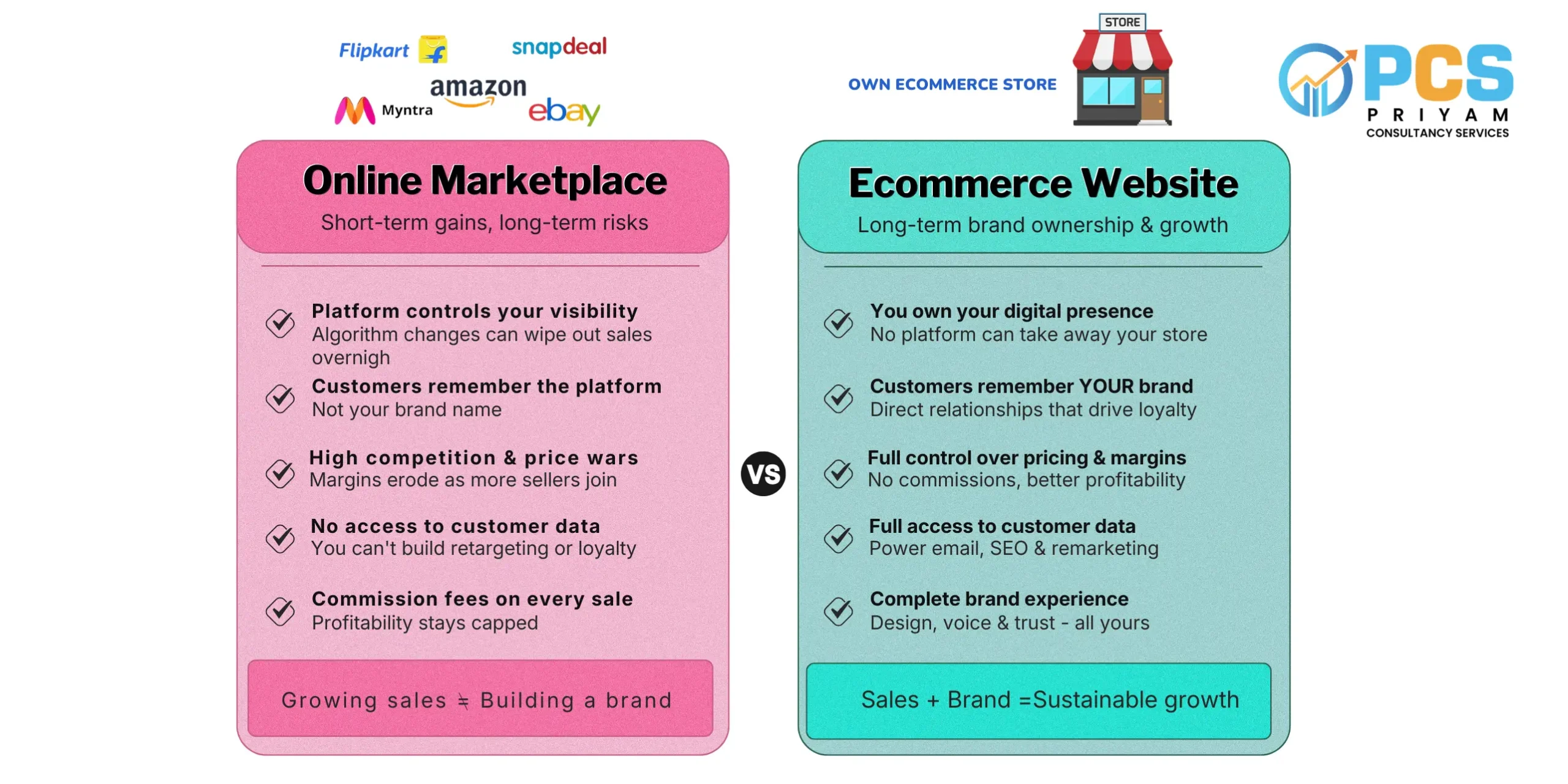
But then reality starts showing up. You realize you are competing with hundreds of similar sellers. Your products sit beside cheaper alternatives. Customers remember the marketplace name more than your brand. And every sale comes with platform commissions, limited control, and growing dependency on algorithms you cannot control.
That is when the real cost of marketplace dependency becomes clear — not just in commissions, but in brand invisibility and customer relationships you never actually own.
The truth is, this was never simply about ecommerce vs marketplace platforms. It was always about control, visibility, profitability, and sustainable business growth. Both models can generate sales. Both can help businesses grow. But they work very differently, and choosing the right strategy can completely change how your business performs online.
This blog breaks down what a marketplace is, how ecommerce websites differ from Online Marketplaces, and which option makes more sense depending on where your business currently stands.

Imagine opening a store inside a massive shopping mall where thousands of people walk in every day already looking to buy something. That is exactly how Online Marketplaces work.
Platforms like Amazon, Flipkart, and Myntra allow multiple businesses to sell products in one shared digital space. Meesho follows a similar model but focuses specifically on social commerce and price-sensitive buyers in Tier 2 and Tier 3 Indian markets. Instead of building traffic on your own, you gain access to an audience that already exists. For businesses trying to enter online selling quickly, this feels like the fastest route to visibility and sales.
This is also why many startups begin with Online Marketplaces before creating their own ecommerce website. The setup is easier, customer trust already exists, and marketplace advertising options help products appear in front of buyers faster. Businesses can start generating orders without heavily investing in website development or long-term ecommerce marketing strategies.
But the convenience comes with trade-offs.
The moment more sellers enter the same category, competition increases. Businesses often find themselves reducing prices just to stay visible. Customers buy products, but rarely remember the brand behind them. Over time, many businesses realize they are growing sales without truly building their own identity.
An ecommerce website is a dedicated online store owned and managed entirely by your business. Unlike marketplaces, you have complete control over product presentation, customer experience, pricing, and marketing.
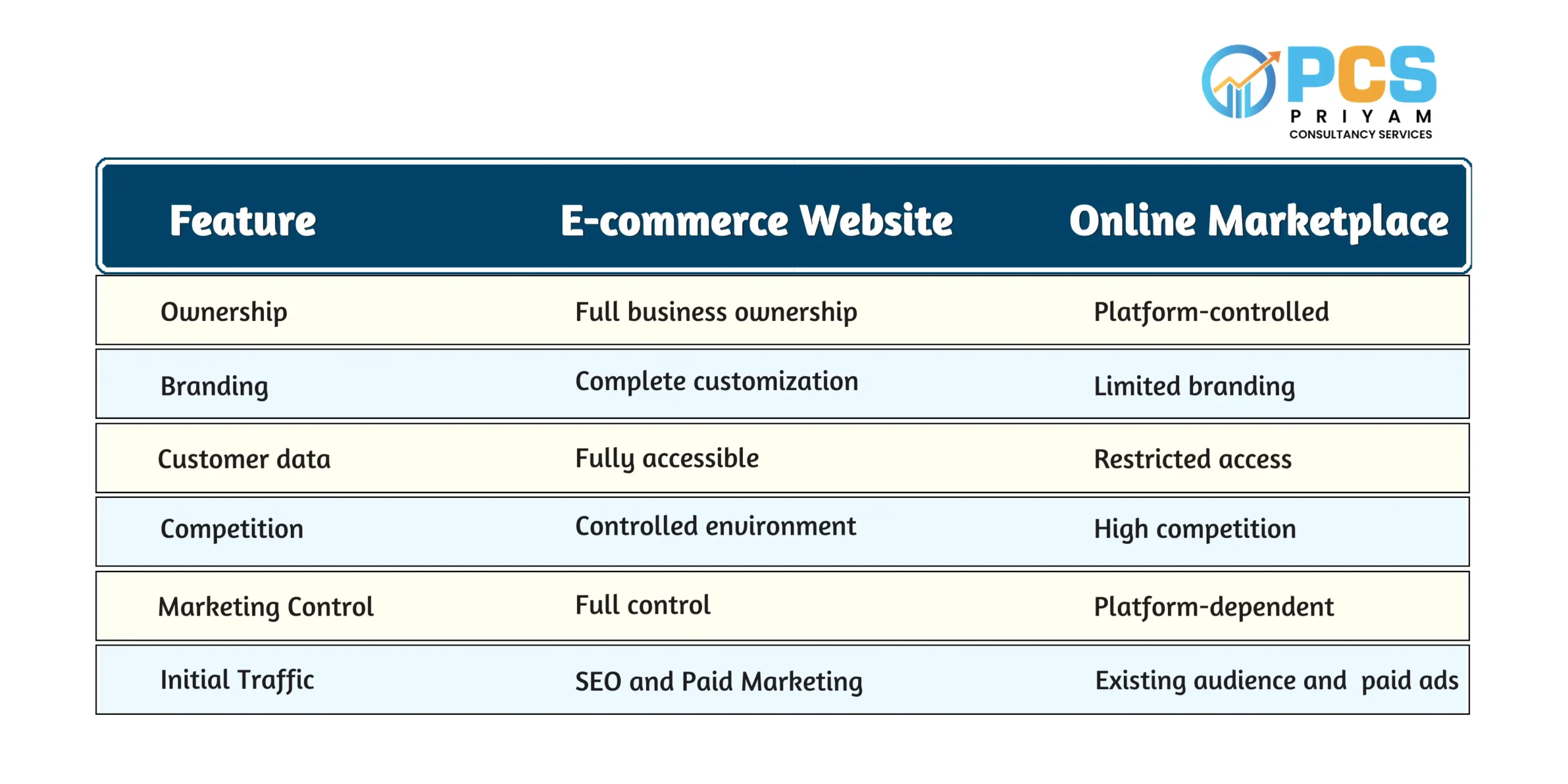
For businesses at an early stage, marketplaces offer the fastest path to first sales. But as you scale, the limitations of platform dependency — restricted customer data, rising commissions, and limited brand control — make building your own ecommerce presence not just an option but a necessity.
Most businesses initially focus on sales. But eventually, every growing business starts thinking about something bigger — brand value.
That is where an ecommerce website becomes incredibly important. When customers visit your own website, they interact directly with your brand instead of a third-party platform. Every product page, design element, offer, and customer interaction becomes part of your brand experience. Over time, this creates familiarity, trust, and recognition that marketplaces simply cannot provide.
An ecommerce website also gives businesses the freedom to grow strategically instead of depending entirely on external platforms. Through SEO, content creation, email campaigns, and ecommerce advertising, businesses can attract customers directly and reduce dependency on marketplace traffic. However, it is important to note that SEO for ecommerce is highly competitive and typically takes 6 to 18 months to show meaningful results. It requires consistent effort and investment, not just a one-time setup.
There is also a significant risk that purely marketplace-dependent businesses overlook — platform risk. Account suspensions, sudden policy changes, or commission increases are real possibilities that can disrupt a business overnight. In India, several sellers experienced sudden account holds during platform policy updates on major marketplaces, losing weeks of sales with no prior notice.
Marketplace advertising works differently. Platforms like Amazon and Flipkart offer built-in advertising tools — Sponsored Products, Sponsored Brands, and display ads — that help sellers appear at the top of search results. This strategy is highly effective for generating quick sales because products appear directly in front of customers already searching to buy.
While marketplace advertising helps products gain visibility inside a platform, ecommerce advertising helps businesses strengthen their own brand identity and customer relationships. Businesses using their own ecommerce website can create personalized campaigns, improve customer retention, and increase long-term profitability.
The strongest businesses rarely choose one strategy alone. They combine ecommerce marketing with marketplace advertising to balance immediate visibility with sustainable growth.
According to McKinsey (2025), Indian MSMEs are already moving in this direction — 53% now prefer D2C channels over marketplace-only selling, and D2C growth is happening nearly three times faster than marketplace growth. India’s D2C market is projected to reach $60 billion by 2027, growing at a 40% CAGR.
Part of the reason behind this D2C shift is straightforward — marketplace fees directly reduce profitability. Amazon India charges referral fees ranging from 2% to 38% depending on the category, with zero referral fees applicable on many products priced under ₹1,000, though fees on higher-priced products remain significant. Flipkart charges commissions ranging from 2% to 22% depending on category, along with fixed fees, shipping charges, and collection fees. These charges compound over time and directly reduce profitability for sellers who rely entirely on marketplace channels.
The most successful businesses do not choose one over the other — they start with marketplaces for reach and scale toward ecommerce for long-term stability and profit.
At PCS, we help businesses build the right balance between marketplace performance and ecommerce growth — with strategies tailored to where your business stands today. If you are ready to move beyond marketplace dependency and build something that truly belongs to your brand, let us show you how.
A marketplace is a shared digital platform like Amazon, Flipkart, or Myntra where multiple sellers list and sell their products to an existing customer base. An ecommerce website is your own dedicated online store that you fully own and control. The key difference is ownership — on a marketplace you are a guest on someone else's platform, while an ecommerce website is entirely your brand's space.
An ecommerce website gives you complete control over how your brand looks, feels, and communicates. You decide the design, the customer journey, the offers, and the messaging. Marketplaces offer very limited branding options — your product sits alongside competitors and the platform's identity always takes priority over yours.
Marketplaces are faster for getting initial traffic because millions of buyers are already shopping there daily. However, even on marketplaces you need to invest in sponsored ads and pricing strategies to stay visible. An ecommerce website requires building traffic through SEO, paid ads, and content marketing, which takes more time but brings customers directly to your brand.
For a small business just starting out, marketplaces are more cost-effective in the short term because there is no website development cost and no need for heavy marketing investment upfront. However, marketplace commissions — ranging from 2% to 38% depending on the platform and category — add up significantly over time. An ecommerce website has higher initial costs but becomes more cost-effective as your business scales.
Yes, and this is actually the approach most successful businesses use. Selling on marketplaces gives you immediate reach and visibility while your ecommerce website builds long-term brand equity and customer relationships. Running both channels together allows you to balance short-term sales with sustainable growth.
An ecommerce website gives you full access to customer data including purchase history, browsing behavior, and contact information, which you can use for personalized marketing and retention strategies. Marketplaces restrict seller access to this data significantly. For long-term growth, owning your customer data is a major advantage that only an ecommerce website provides.

AI Search Optimization: How to Get Your Business Found in ChatGPT, Gemini and Google AI Search Search no longer ends...
WordPress: How AI Is Transforming Website Development and Management WordPress AI website development has moved from a collection of third-party...
HR Consulting Services: What Growing Businesses Actually Need Most founders don’t think about HR until something forces them to —...