AI Search Optimization: How to Get Your Business Found in ChatGPT, Gemini and Google AI Search Search no longer ends...
Strong organizations are not defined only by great leaders — they are defined by their ability to continuously build the next generation of leadership.
That is where succession planning in HR becomes a critical driver of long-term business success. Whether it is preparing future CXOs, strengthening internal leadership pipelines or aligning with broader HR strategy and planning, organizations today cannot afford to treat succession as a reactive process.
At its core, succession planning in HRM ensures that leadership transitions do not disrupt momentum. Instead, they become opportunities for growth, stability and strategic evolution.
In this blog, we break down the internal vs external hiring debate, explore what effective succession management plans look like and provide a practical framework for building a future-ready workforce management strategy.
Mistake 1 — Treating it as a one-time exercise — Many organizations create a plan and revisit it only when a vacancy arises. In reality, succession planning in HRM must be continuous, evolving alongside business needs.
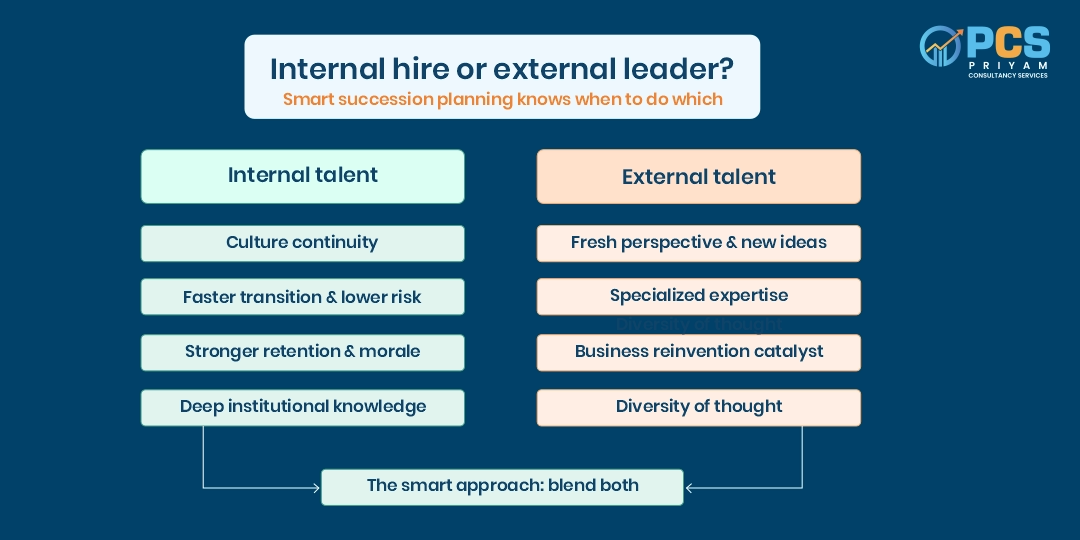
Culture continuity
Internal candidates understand the organization’s values, systems and people dynamics.
Stronger retention and morale
Promotions signal growth opportunities, strengthening employee engagement and loyalty.
Faster transition
Internal hires require less onboarding and adapt quickly to leadership roles.
Lower risk
Their performance, strengths and gaps are already known, reducing uncertainty.
Best suited when:
● Culture is a key competitive advantage
● Roles require deep institutional knowledge
● A strong internal talent pipeline exists
Fresh perspective External leaders challenge existing thinking and introduce new approaches.
Specialized expertise
Critical during transformation phases like digital adoption or expansion.
Business reinvention
External hires can accelerate change when organizations need a reset.
Diversity of thought
Brings varied industry exposure and innovative problem-solving..
Best suited when:
● Strategic transformation is required
● Internal pipeline lacks readiness
● New capabilities are needed
This include:
● Mapping internal talent against future needs
● Using HR analytics to assess readiness and skill gaps
● Maintaining external talent pipelines
● Aligning hiring decisions with long-term workforce planning goals
This balanced approach ensures agility without compromising stability.
One important note: Research consistently shows that external CXO hires carry a significantly higher failure rate in the first 18 months compared to internal promotions. The onboarding curve, cultural fit challenges and time-to-effectiveness are all steeper for external leaders — a cost that organizations must weigh carefully before bypassing their internal pipeline.
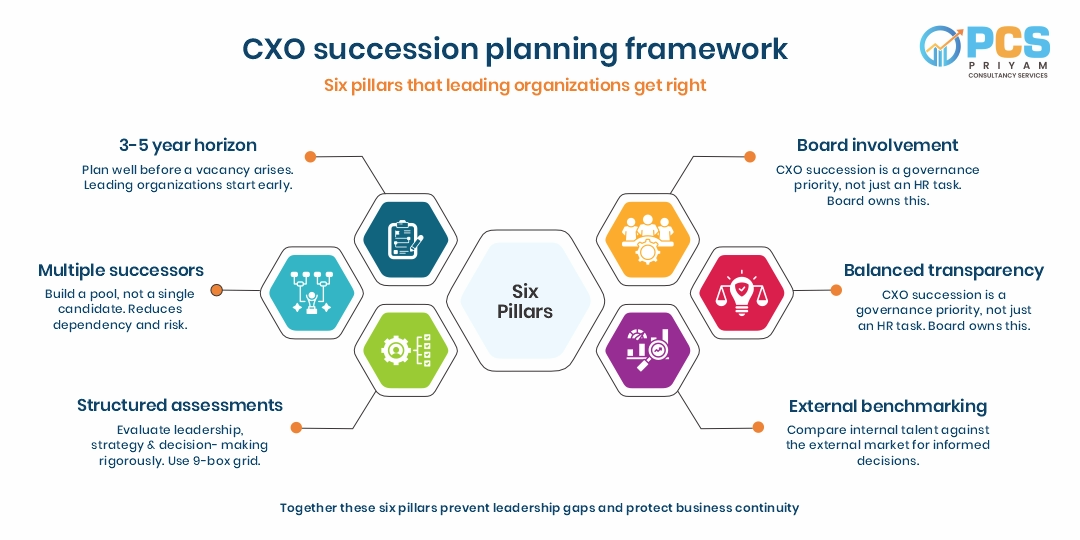
CXO succession planning represents the most critical layer of succession planning in HR. Leadership transitions at this level directly impact business continuity, investor confidence and organizational stability.
Many organizations now partner with experts offering CXO Succession Planning Services to ensure structured and unbiased decision-making.
1,Leading organizations
typically plan 3–5 years in advance, though timelines vary by industry and organizational complexity.
2. Multiple successors
A pool of candidates reduces dependency on a single individual.
3. Structured assessments
Evaluation across leadership, strategy, decision-making and stakeholder management.
4. Board involvement
Succession at the CXO level is a governance priority, not just an HR responsibility.
5. Balanced transparency
Clear communication without overpromising roles.
6. External benchmarking
Comparing internal talent with external leaders ensures informed decisions.
Poor CXO succession decisions can lead to financial loss, cultural disruption and talent attrition. Getting it right is a strategic necessity.
Succession planning is a core component of effective workforce management and broader HR strategy and planning.
Step 2 — Evaluate Talent Pipeline
Use tools and HR analytics to identify high-potential employees and readiness gaps.
Step 6 — Measure and Improve
Track metrics like promotion rates, retention and time-to-fill roles to refine your strategy.
A strong workforce strategy ensures organizations remain resilient, agile and prepared for change.
As organizations scale, leadership continuity becomes a defining factor in sustaining momentum. Priyam Consultancy Services partnered with two fast-growing SaaS companies—one in IT and another in Health Tech—to address critical leadership transitions using a structured and strategic succession planning approach.
In the first scenario, an IT SaaS company was experiencing rapid growth but faced a significant leadership gap at the CXO level. While the organization had a strong mid-management pipeline, it lacked leaders ready to take on high-impact executive responsibilities. PCS conducted a comprehensive leadership needs assessment aligned with the company’s growth trajectory and culture. Instead of making a rushed decision, we mapped required competencies, benchmarked against market talent, and identified the right external CXO—someone who brought both strategic foresight and deep industry experience. The result was a seamless leadership transition that strengthened the company’s ability to scale without disrupting internal stability.
In contrast, a Health Tech SaaS company approached PCS with a similar leadership challenge but a different opportunity. With a senior leader exiting, the initial instinct was to hire externally. However, through a structured succession audit, we identified a high-potential internal candidate with strong foundational capabilities. By designing a focused development and grooming plan, we enabled this individual to step confidently into the senior role. This approach not only reduced hiring costs but also preserved institutional knowledge and reinforced team culture.
The real strength of succession planning in HR lies in intentional preparation.
Organizations that succeed share three traits:
● They build leadership pipelines early
● They rely on data, not assumptions
● They stay flexible in decision-making
In a rapidly evolving business landscape, companies that align succession with workforce management and HR strategy and planning will always stay ahead.
At Priyam Consultancy Services, we provide end-to-end HR services including payroll management, recruitment services, and HR strategy and policy development, along with specialized expertise in succession planning frameworks and CXO Succession Planning Services — all tailored to align with your business goals.
Succession planning is strategic and long-term, while replacement planning is reactive and focuses on immediate backfilling.
There is no single answer—internal hiring offers stability and cultural fit, while external hiring brings fresh perspectives and new capabilities. A balanced approach works best.
Treating it as a one-time activity, focusing only on top roles, ignoring high-potential talent, and lacking data-driven decision-making.
By identifying critical roles, assessing talent readiness, developing future leaders, using HR analytics, and aligning succession with overall HR strategy and planning.
AI Search Optimization: How to Get Your Business Found in ChatGPT, Gemini and Google AI Search Search no longer ends...
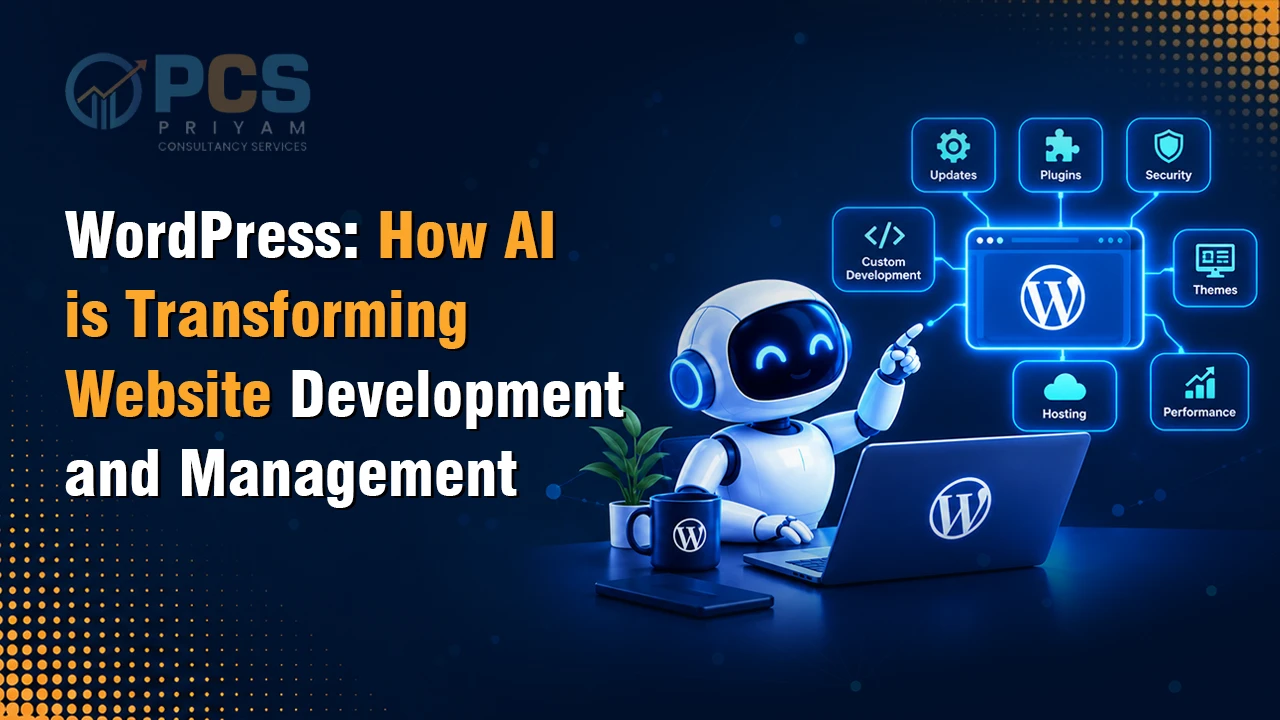
WordPress: How AI Is Transforming Website Development and Management WordPress AI website development has moved from a collection of third-party...
HR Consulting Services: What Growing Businesses Actually Need Most founders don’t think about HR until something forces them to —...